So how would you like to define “addiction”? We all know that there are several proper definitions of it according to study fields like medical science, psychology, and many more. Yet, I’m asking you to define it because I believe it’s important to define such things by ourselves. Because before defining it by yourself, you will take some time to think about it – how you feel about it, and I think that is what’s really important. Of course, I am not telling you to ignore the proper dentitions provided by the experts – we will definitely take those definitions and studies into account as we move forward.
To me “addiction” is a habit that one does not have control over. The starting of it may be simple or fun, but as time passes the habit does not stay as simple as it was in the beginning. It becomes so complicated that overcoming it needs a really powerful force. Along with it, I think the habit of “addiction” harms the one who is addicted, it also may harm the ones close to that person, and it surely has detrimental environmental, social, economic, and health aspects.
How real is Fast Fashion Addiction?
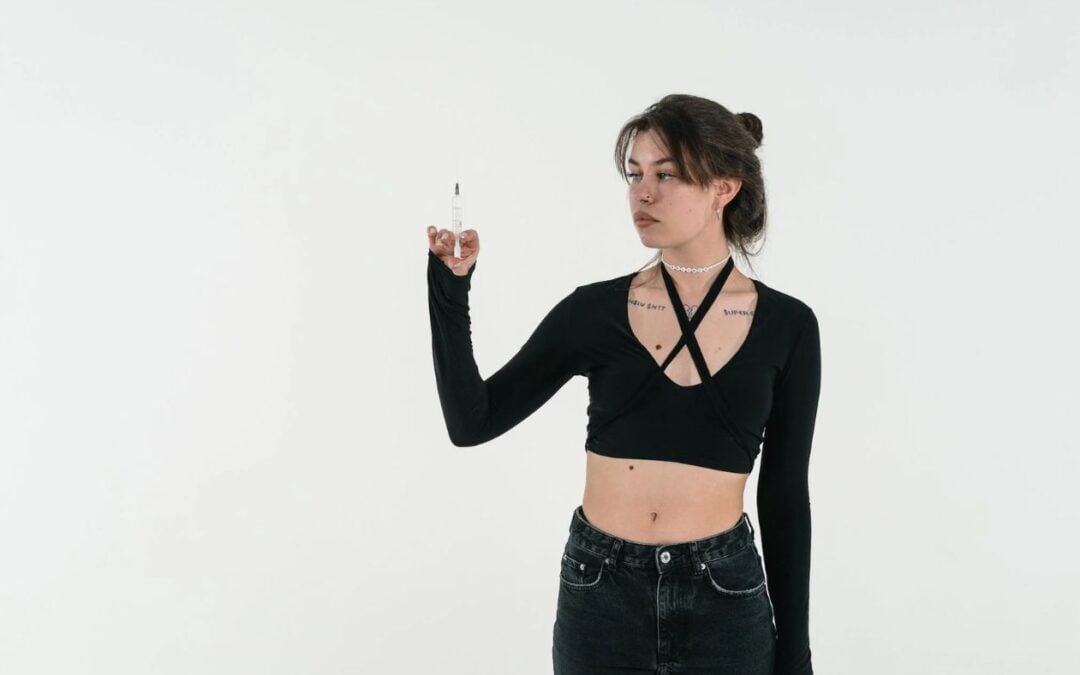
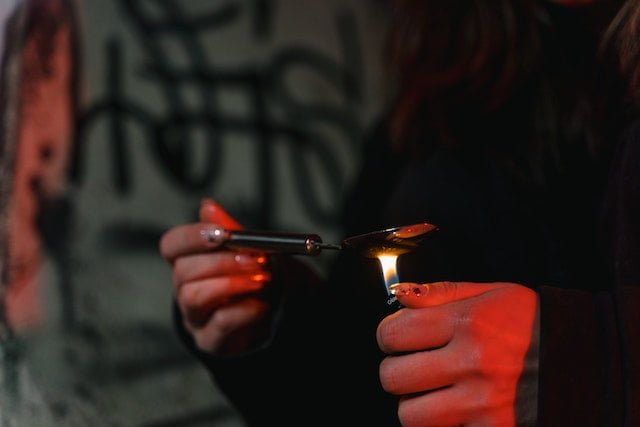
Let’s think about a narcotic substance that surely causes addiction. Let’s consider cocaine for the sake of the discussion. The first experience of cocaine for someone mostly starts due to simple reasons like curiosity, fun, or the fact that everyone else is doing it – the enjoyment really feels worthwhile. But as the habit grows, the person who started it due to simpler reasons gets into a solid web. Parties and hangouts become less fun if there’s no cocaine. Friends who have the connections to supply become closer friends. Numbers of drug dealers get saved in the phone books. Money starts to vanish. Health starts to go bad. Family and good friends start to get worried. To maintain the supply of cocaine “The War on Drugs” continues to fail, people get tortured, enslaved, and killed.
Now you might ask – “Seriously? You are comparing my shopping habit to something so harmful?”. My answer would be – “Yes! But I don’t have anything against you. I am simply trying to paint a picture for both of us to understand this more clearly.”
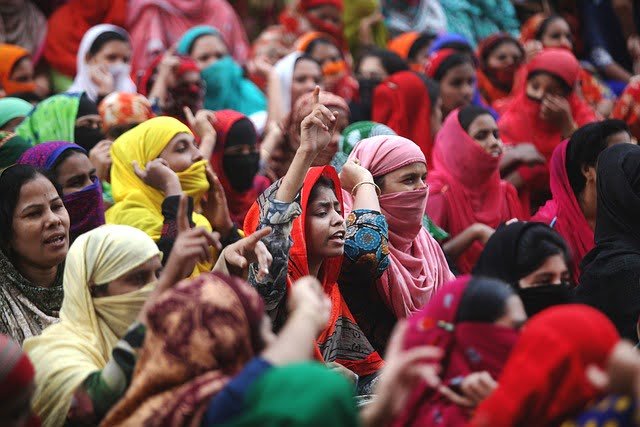
From what I understand, following fast fashion or following new trends is fun at the beginning – because it’s simple to follow trends ( no need to think much about our own point of view of style ). It’s also something that almost everyone is doing around you – so it’s easier to join that team. It’s super available. It’s cheap – because the industry that’s producing it is surely using cheap materials to produce those, not providing proper wages to the real producers of those items in the best-case scenarios because, in the worst-case scenarios, we still hear about modern-day slavery of the garment workers.
Now let’s talk about the detrimental effects of it. To keep up with the trends – to hang out with those friends, to join those parties; you need to keep buying the latest trends. Just like the drug dealers on speed dial, you have all the apps that you need to keep ordering new ones – otherwise, you will be the one who will feel like an outcast at the next party. Now to keep buying those, you need a constant flow of money and if you don’t have that – well they will be sold to you for credit, you will prioritise that over your basic needs.
Now let’s think about the social effects. By seeing you following the trends, your friends will be more intrigued to follow those too. I am saying “more” because the industry through its amazing marketing and advertising has fruitfully convinced us that – it’s important, it’s fun, and it’s the only way to stay relevant. So, when you’re someone who’s following those, you’re doing free marketing for the industry too – your friend who is being inspired to do so by seeing you (along with the advertisements and seeing others) and probably considering it more important than basic needs too, just like you.
If you think about the environmental effects of it – it gets more serious. To keep the price low, the industry seeks cheap materials. Those materials don’t last, but you won’t be wearing them after a few times eventually, so it doesn’t matter! So for those cheap materials, the industry turns to detrimental environmental practices of production which ensures bountiful materials at a cheap rate, and for that toxic chemicals are used. When those toxic chemicals get released into our water and air and soil, all of those get polluted – it affects our food production, puts our water security at threat, makes us inhale toxins harmful to our bodies. The process through its pollution affects all the other species too. Not to mention, to bring that product to your doorstep a huge amount of fuel is burned – the cost of which is way more than what you’ve paid for.
The health concerns now! I’ve already said how the production process can affect our environment. How tough it is to understand that what’s bad for the soil, the water, the air, and for other species – is harmful for us too? By wearing those things we let our bodies be in direct connection to those harmful materials.
Now let’s paint the picture for real
Let’s see how addiction is defined by the experts. According to the website of the NHS – “Addiction is defined as not having control over doing, taking or using something to the point where it could be harmful to you.”, it is also mentioned that while addiction is mostly associated with drugs, gambling, alcohol, and smoking; it is also possible to become addicted to things like shopping, internet or even work.
This is what the American Psychiatric Association says about addiction – “Addiction is a complex condition, a brain disease that is manifested by compulsive substance use despite harmful consequences.”
So according to these definitions, we can surely say that:
“Not having control over” – is a major factor of addiction.
It is a complex condition.
It is possible to become addicted to shopping.
Despite harmful consequences, addiction goes on.
Can’t we all relate it to what I have said earlier about the addiction to fast fashion?
Let’s get inside the brain to understand fast fashion addiction
The whole idea of “addiction” is very complex, and what I have found out is – that there are many reasons behind the addiction to fast fashion too.
One of the most common things is something called FOMO (fear of missing out), but I guess you all know about it. This is what the European Union says about FOMO – “FOMO is an overwhelming fear that other people at any given time are participating in exciting experiences in which you are not part of”. Social media plays an important part in spreading this, and fast fashion brands are using it perfectly. They are constantly offering discounts that do not last long, showing photos of clothes that celebrities are using and claiming that the stock of those clothes is limited, and constantly releasing new designs to make you feel that you have missed the last trend and this new one won’t last long too; so you need to grab it right now!
Shopping can be addictive, and fast fashion brands know it well. According to a study by a team of researchers from Stanford, MIT, and Carnegie Mellon – the pleasure center of the brain gets activated when a person comes across something that she/he/they wants to buy. The more the person wants the item, the more the pleasure center in the brain gets active, and when the item can be purchased at a cheaper rate, the brain gives the maximum sense of pleasure.
Now fast fashion brands produce about 52 micro-seasons in a year or one new collection a week! Just think about, every week how many clothes they are putting on display for you to see and desire. The cheaper the clothes, the more people desire them, the more people purchase them, and the more you see them on social media ( because people like to show what they bought, that they are keeping up with the trends, and the brands encourage everyone to keep posting photos and videos of their clothes that people bought and tag the brands in those contents; that’s what “fashion hauls” are ), and the more you desire to own them too. The crazy part is, that this cycle goes on every week, and the fashion industry keeps feeding this loop in our brains which creates an effect something very similar to addiction.
To keep this cycle of consumption alive a culture of mindless consumption and throwing away has been established. There is a huge group of consumers who believe that they do not want to be seen in an item more than once because that might give others the idea that they have gone out of style! It’s important to point out that by “being seen” they mean that, they do not want to appear on social media twice in the same piece of garment!!
Let’s Calculate the Numbers for Fast Fashion Addiction
For the sake of the calculation, let’s say your favorite brand is H&M and you are someone who is willing to buy every week from their new collections. If you buy something in the price range from $20-$40 from them every week, then at the end of the year the amount of all your purchased items from this brand will be somewhere around $1040 – $2080 ( calculated in reference to 52 seasons a year ), and that is just one brand, and that is just a moderate pricing range considering different socio-economic situations. After this, to go with these clothes, you will need accessories and shoes too!!
Now think about that friend of yours who is super inspired by your shopping habit to do so! That’s another $1040 – $2080 dollars, plus the accessories and shoes!
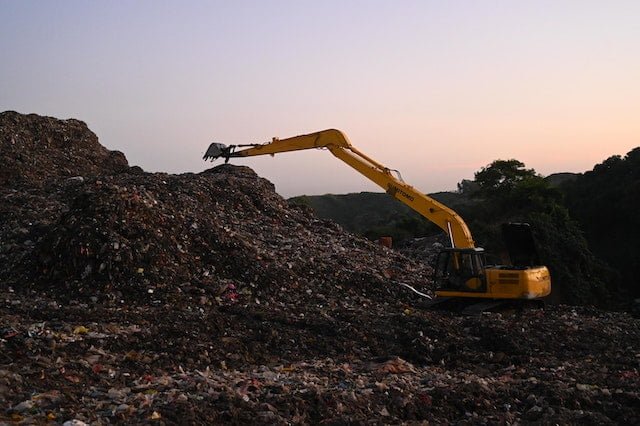
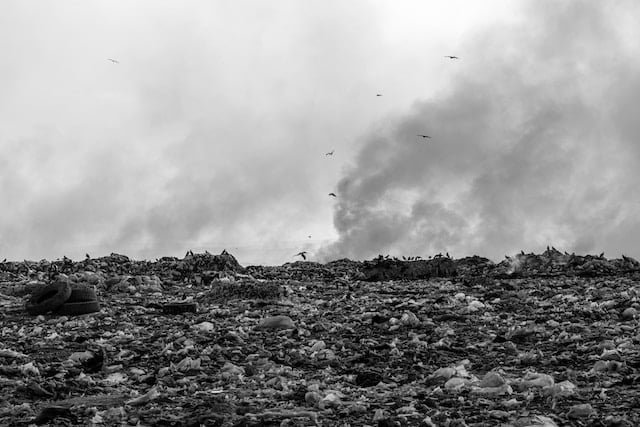
Now, let’s talk about environmental numbers. Between 80 and 100 billion new clothing garments are produced globally every year, and from these new garment, 92 million tonnes end up in landfills. This means a rubbish truck full of clothes ends up in landfills every second, and this industry is expecting to grow more every year! More importantly, around 60% of all clothing material now is synthetic fibers, which means plastic – nylon, acrylic, polyester, etc. The textile industry generates 42 million tons of plastic waste per year. Every time you wash a synthetic garment, it releases tiny plastic microfibers into the water. Up to 500,000 tons of microfibers end up in the ocean every year. This industry accounts for 9% of annual microplastic pollution added to our oceans. This is just a tiny fraction of the whole environmental problem caused by fast fashion, and it is expected that the apparel industry’s global emissions will increase by 50% by 2030 if the business-as-usual scenario continues. Along with every kind of plastic pollution, the fast fashion industry harms our environment through the usage of textile dyes, and pesticides, overproduction of low-quality garments that end up in landfills ( and creates waste colonialism too! ), excessive usage of water and water pollution, emissions from the transportation sector due to long supply chains and global shipping, energy-intensive production process which is heavily dependant on fossil fuels, methane emissions from the landfills due to overproduction of low-quality garments made mostly from synthetic fiber and waste colonialism.
It is not tough to understand that all of these adverse environmental impacts are harmful to our health too. Plastic pollution can damage human cells and can lead to infertility, obesity, diabetes, prostate or breast cancer, thyroid problems, and an increased risk of cardiovascular disease and stroke, among others. Prolonged exposure to textile dyes can lead to skin allergies, respiratory problems, hormonal imbalances, and even certain types of cancers. Methane emissions reduce the amount of oxygen breathed from the air and cause mood changes, slurred speech, vision problems, memory loss, nausea, vomiting, facial flushing and headache, lung diseases, asthma attacks, cardiovascular morbidity, and mortality, and heightened stroke risk. These are just some of the health effects that can be caused by the pollution generated by the fashion industry, and if you still want to learn more about it, I am sure you can google it and learn from verified sources.
All the other adverse effects
At this point of the article, I am really feeling overwhelmed and tired to even talk about all the other negative impacts caused by fast fashion, but they surely include serious factors like – labor exploitation, deforestation, biodiversity loss, ecosystem collapse, etc.
How to overcome the fast fashion addiction
Now that we’ve explored the deep-rooted addiction that fast fashion can become, it’s time to shed light on breaking free from this cycle. Embracing a sustainable, eco-conscious approach to fashion and lifestyle is not only a remedy for our planet but also for our well-being.
Slow Down, Choose Quality: Shift your focus from quantity to quality. Invest in timeless pieces that are made to last. Seek out brands that prioritize durability and craftsmanship. Remember, a well-made, classic garment can serve you for years, saving you money in the long run.
Circular Fashion: Embrace circular fashion principles. Explore thrift stores, vintage shops, and second-hand markets. Not only will you find unique pieces with character, but you’ll also extend the lifespan of clothing and reduce waste.
Regenerative Fashion: Support regenerative fashion practices. Look for brands that prioritize sustainability, ethical labor practices, and environmental conservation. These brands often use eco-friendly materials, reduce waste, and contribute positively to local communities.
Capsule Wardrobe: Simplify your wardrobe with a capsule wardrobe. Choose versatile, mix-and-match pieces that suit your style. This minimalist approach reduces the temptation to constantly buy new clothes.
Mindful Consumption: Before making a purchase, pause and reflect. Ask yourself if you truly need the item or if it’s just a fleeting trend. Consider its impact on the environment, and opt for eco-friendly materials like organic cotton, hemp, or recycled fabrics.
DIY and Upcycling: Get creative! Learn basic sewing and repair skills to mend and upcycle your clothing. Transform old items into new, unique pieces. It’s a fulfilling way to reduce waste and express your individuality.
Educate Yourself: Stay informed about the fashion industry’s impact on the environment and society. Understanding the consequences of fast fashion can motivate you to make more conscious choices.
Community and Swap: Organize clothing swaps with friends and family. It’s an enjoyable way to refresh your wardrobe without spending money and gives previously-owned garments a new life.
Support Sustainable Brands: Discover and support sustainable fashion brands and designers. They’re leading the way in creating clothing that’s stylish, eco-friendly, and ethical.
Spread Awareness: Share your journey towards sustainable fashion with others. By raising awareness and educating friends and family, you can collectively reduce the demand for fast fashion.
Breaking free from fast fashion addiction isn’t just about changing our habits; it’s about transforming our perspective on fashion and consumption. It’s a shift towards a lifestyle that’s not only better for us but for our planet and future generations. Remember, small changes lead to big impacts. Together, we can create a fashion industry that values quality, sustainability, and ethical practices over mindless consumption.
How you dress is an expression of your identity, so explore and express yourself mindfully – let fashion be a force for good.
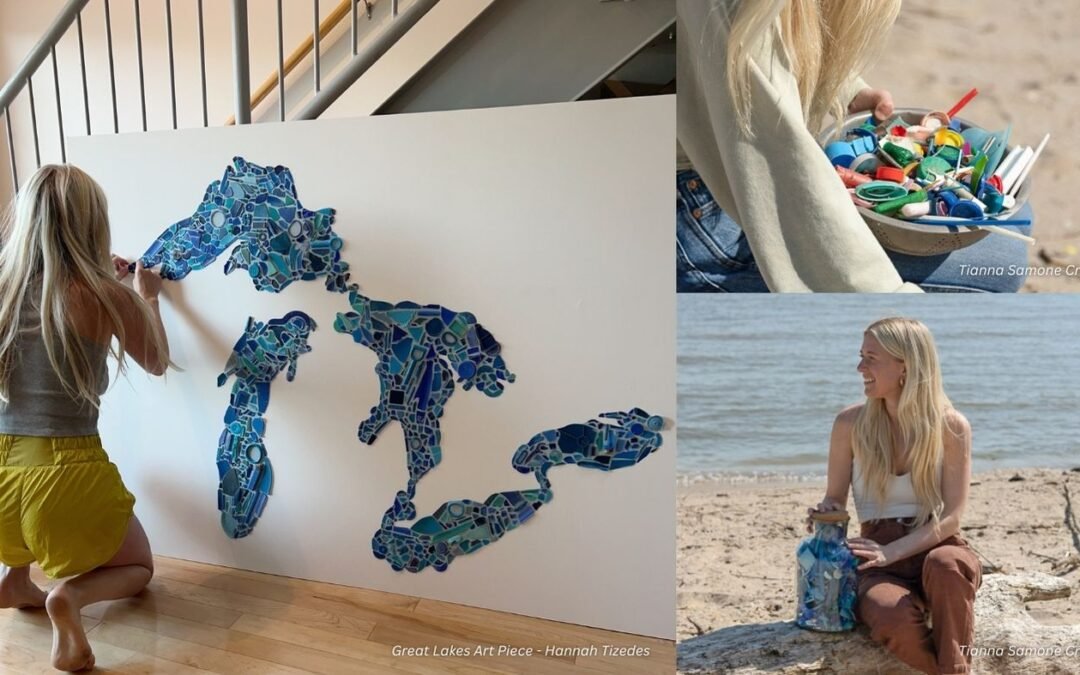
In a world fraught with environmental challenges, the synergy of art and activism has emerged as a potent force for change. Meet Hannah Tizedes, an extraordinary artist and environmental activist. Raised amidst the natural splendor of Michigan and the majestic Great Lakes, Hannah witnessed the disheartening sight of litter washing ashore on these pristine beaches. This experience ignited her passion for environmental conservation.
Hannah’s journey epitomizes the transformative potential of creativity. She embarked on a mission to collect plastic debris from beaches worldwide, fashioning these discarded fragments into captivating works of art. Her art serves a dual purpose: raising awareness about plastic pollution and climate change, and inspiring individuals to take concrete actions for a cleaner, more sustainable planet. In this exclusive interview, Hannah shares her inspirational odyssey, the genesis of The Cleanup Club, and her insights on the intersection of art and environmental advocacy.
Dive into her world, where vibrant creativity converges with climate activism, and discover how Hannah is kindling hope amidst the formidable challenges of our time.
Can you tell us about your journey as an environmental activist and artist? How did you become interested in addressing environmental issues through art?
I was raised by creative and resourceful parents. My mom was always crafting or pit-stopping at garage sales and my dad was always entertaining my elaborate clubhouse buildout ideas or building something functional out of scrap materials. But it wasn’t until later in my life that I came to appreciate those acts for who they made me today.
At university, I paired my creative studies with sustainability studies, worked at the campus recycling center where I was able to explore fun creative projects, and began collecting trash from my travels around the world & the Great Lakes for art pieces I was brainstorming. After learning more about plastic pollution and seeing it from coast to coast, but especially its impact on my home state’s shorelines, I knew I wanted to use my creativity as a vehicle for change. My hope is and was to create art that makes people take a deeper look – literally and figuratively – at the impact plastic pollution has on the planet. I hope people feel inspired to do what they can, with what they have, wherever they are for a less trashy earth.
You have a very unique style of creating your artworks with plastic, and microplastic. Why did you choose this medium?
I’m from Michigan, so I grew up surrounded by the Great Lakes. These lakes hold ~90% of the US’s freshwater, provide drinking water to 40+ million people, offer endless amounts of beauty, and are home to thousands of plants and animals. They’re so special. And yet every year it’s estimated that around 22 million pounds of plastic pollution enters them. At the same time, I have always been captivated by the rainbow of plastic I find on their shorelines. So I created something with those pieces to help tell the story I was witnessing.
Photo Courtesy – Tianna Samone Creatives
As the founder of The Cleanup Club, could you tell us more about the initiative and its goals? How do you encourage others to get involved in cleaning up their communities and reducing plastic waste?
The Cleanup Club is a nonprofit dedicated to educating communities on Great Lakes plastic pollution while having fun through cleanups, collaborations, conversations & creativity. I think so often people feel overwhelmed with climate news or plastic pollution news, yet they want to help make the world a better place. And I wanted to help make that super simple while building a community of people that care. It doesn’t matter if you’re an engineer, local barista, or school teacher – everyone is welcome to join in. I also do my best in providing uplifting experiences for everyone so instead of walking away from a cleanup thinking “shit, that was a lot of trash, what now?” people can walk away with resources to local zero-waste shops & refillers, with fun sustainable giveaways in hand, and more. That way, their positive impact doesn’t just stop at the cleanup.
What challenges have you faced as an environmental activist and artist? How do you navigate these challenges and stay motivated to continue your work?
I always try to look at the bright side of things. The little actions add up and it’s really incredible to have people tell me that they’re inspired by my work and because of it, they did X, Y, or Z. I’ve definitely hit bumps in the road where I’ve thought, “what is this all for?” or “does my work even matter?” but then I go outside and I’m reminded of my why. The beauty of this amazing planet we get to call home is the best reminder out there and that’s why I continue to advocate to protect it.
How do you believe art can be a powerful tool for raising awareness about environmental issues? What role do you think art can play in inspiring action and driving positive change?
I believe art is an incredibly important tool in raising awareness about environmental issues. Art makes us feel something. Art is powerful. Whether it’s through music, painting, literature, photography, and so on, art has the ability to story-tell so many different narratives when it comes to issues we feel deeply about. I think that inspiration can then be transformed into action and the art can be used as a vehicle for positive change.
How do you think artists can collaborate to make the climate movement stronger and more fruitful?
There are endless possibilities for artists to collaborate and help convey moving messages regarding climate change. I think we’re continuing to see more collaborations around these topics which is wonderful, however, I think we do need to be aware of greenwashing when it comes to brand collaborations and partnerships and stay true to our ‘why’ in this work (aka Earth).
As an artivist, how do you balance the artistic and activist aspects of your work? How do you ensure that your art remains impactful and thought-provoking while also conveying a message of hope and empowerment?
I love making my work colorful. For me, that’s really important because I think colorful things are joyful. I also do my best at providing context behind materials I use to help educate people on things I’m finding on the beach like microplastics, mesoplastics, etc. while providing ways to take action through policy and local advocacy efforts.
I think optimism in all aspects of life is a wonderful thing. The world we live in nowadays can be filled with so much doom & gloom, so like José Gonzalez, Founder of Latino Outdoors said, we need more “do and bloom” instead.
What would your advice be to someone in the climate movement who feels hopeless and burned out?
The weight of the planet does not need to sit on your shoulders. It is a collective effort towards a better future for all. Whenever you’re feeling down, get outside. Kick off your shoes and go play in nature. Then, find a local organization making a positive impact and get involved. A community can be so healing too – to both ourselves and the planet.
Filled with gratitude and love for the people, places, and spaces I get the opportunity to know, explore, and nourish. I’m less focused on how I want the future to look and more focused on how I want it to feel.
Who are your biggest inspirations?
There are so many but at the end of the day, I love watching people thrive and grow doing what they love. Those are the people who inspire me most, people who follow their passions – and bonus points when it’s an earth-friendly passion, of course.
How can others join you in the climate movement or support your work?
People can feel free to follow my work on Instagram, @hannahtizedes, (where I share the majority of my art & advocacy), and/or follow my nonprofit’s work and learn more about Great Lakes plastic pollution and our efforts to protect them at www.thecleanupclub.org.
This is a part of a series where Green & Beyond Mag explores the stories and takes a peek at the lifestyles of incredible people like green entrepreneurs, innovators, climate advocates, activists, community leaders, and content creators, all around the world, who love the planet, and are working tirelessly to make the world a better place.
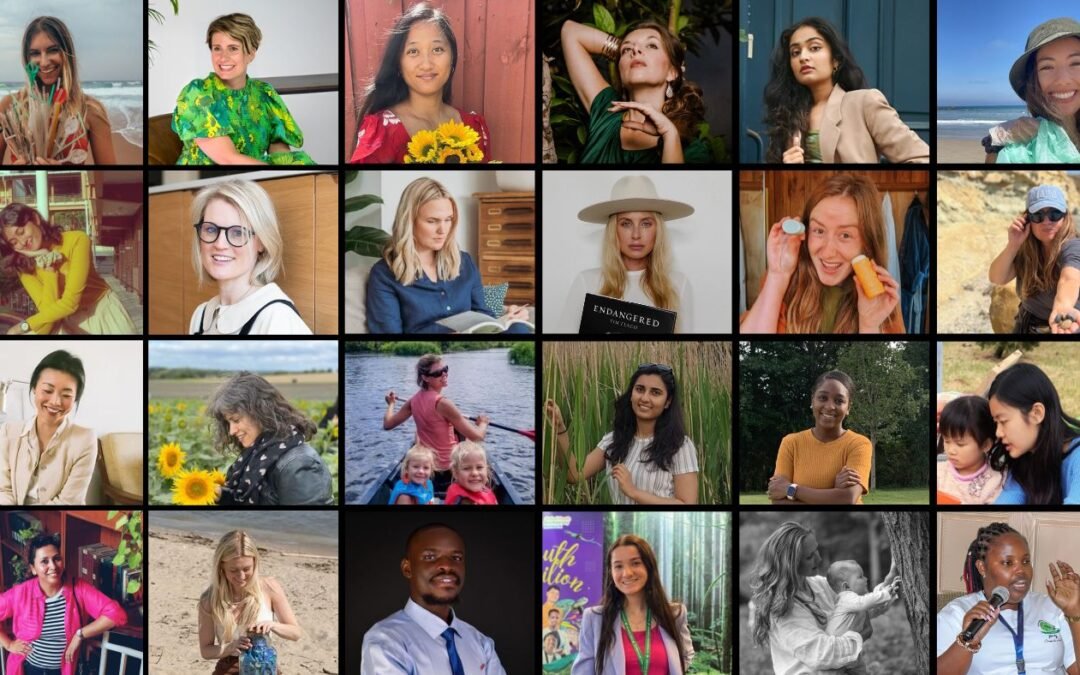
As the Plastic Free July campaign comes to a close, we find ourselves filled with inspiration and gratitude for the incredible community of climate activists, sustainable lifestyle enthusiasts, and eco-conscious individuals who came together to make a difference. Throughout this transformative month, we’ve had the privilege of hearing from a diverse group of inspiring individuals, including climate activists, sustainable lifestyle content creators, conscious entrepreneurs, and more. Their valuable insights have shed light on the importance of reducing plastic consumption and the positive impact it can have on our planet and our lives. It’s now time to recollect what we’ve learned throughout the month, so we can continue to make conscious choices every day to protect our planet and create a greener, healthier future for generations to come.
The Impact of Plastic Pollution
Tania Roa, a passionate climate activist, reminds us of the undeniable truth that plastic pollution is a result of the overuse of fossil fuels. From production to consumption, the entire lifecycle of plastic generates excessive pollution that our planet struggles to bear. Plastic waste infiltrates waterways, endangers wildlife, and even finds its way into our bodies. However, Tania also instills hope, urging us to remember that humans once lived without plastic and that we can reclaim our lives from plastic’s grip. She advocates for reuse, upcycling, and opting for plant-based materials whenever possible to make a positive difference.
Inanna, a musician and climate advocate, sheds light on the urgency of long-term thinking in tackling plastic pollution. She sees plastic as a symbol of a throwaway culture that prioritizes short-term convenience over the planet’s well-being. Recognizing that the Earth’s resources are finite, Inanna calls for a collective shift towards sustainable, ecological, reusable, and compostable alternatives to single-use plastics. By embracing change and questioning our habits, we can drive a vital transformation toward a greener, cleaner future.
The Multi-Faceted Importance of Reducing Plastic Consumption
Winnie Cheche, a dedicated climate activist, articulates the multiple benefits of reducing plastic consumption. By minimizing plastic waste, we protect our environment, preserve resources, and combat climate change. Plastic pollution has far-reaching consequences, affecting human health, wildlife, and the delicate balance of our ecosystems. Winnie’s call to action is an urgent reminder that protecting our planet is a collective responsibility.
Natalie Chung, a passionate climate advocate, eloquently highlights the suffocating reality of plastic pollution on our planet. From microplastics in Antarctica to the farthest reaches of our oceans, plastic waste knows no boundaries. Natalie’s message is clear: we must take control of our plastic addiction before it takes control of us. By reducing plastic consumption, we secure a safer, healthier environment for current and future generations.
Addressing Climate Change and Promoting Conservation
Lamech Opiyo, a driven climate activist, stresses the crucial role of reducing plastic consumption in mitigating climate change. The life cycle of plastic, from fossil fuel extraction to disposal, contributes significantly to greenhouse gas emissions. By reducing our plastic footprint, we can champion sustainable waste management and conserve valuable resources. Lamech’s message resonates strongly with the idea that a safe and healthy environment is essential for our well-being and that of our planet.
Holding Corporations Accountable and Creating Ripple Effects
Niha Elety, an influential climate advocate and eco-entrepreneur, calls for collective action to hold fossil fuel companies accountable for their plastic waste. By driving demand for eco-friendly materials and reusable alternatives, individuals can inspire systemic change and transition towards a circular economy. Her powerful message is that, as a collective force, we can challenge corporate practices and spark a wave of sustainable innovation.
Puja Mishra, an eco and slow-fashion advocate also emphasizes the power of individual actions in creating a ripple effect for positive change. Each small step we take towards a plastic-free lifestyle contributes to a monumental shift in behavior, ultimately leading to a more sustainable world. Puja’s lesson reminds us that every eco-conscious choice matters and inspires us to be catalysts for collective change.
Margarita Samsonova, an influential eco-advocate and eco-entrepreneur, emphasizes the power of education and community engagement. By sharing our plastic-free journey and advocating for sustainable choices, we can inspire others and drive the collective change needed to protect our planet.
Celebrating Sustainable Fashion and Empowering Change
Clementina Martinez, a multifaceted sustainable fashion designer, and filmmaker, passionately advocates for reducing plastic consumption. She reminds us that the harmful impact of plastic waste goes beyond environmental damage; it affects our DNA, infiltrating our unborn babies and jeopardizing future generations. Embracing history as our guide, Clementina encourages us to reject the notion that we need plastic in our lives and instead, pave the way for a plastic-free future.
Alex Standley, a sustainable fashion stylist, also sheds light on the importance of making fashion more sustainable to combat plastic waste. By supporting eco-friendly and ethical fashion choices, we can significantly reduce the fashion industry’s plastic footprint. Alex’s lesson shows us that embracing sustainable fashion can be a powerful way to protect the environment.
Monica Richards, an eco-advocate and TV personality focuses on two crucial aspects of a plastic-free lifestyle: tackling microplastics and embracing minimalism. By switching to laundry and dishwasher pods, she ensures that microplastics do not leach into the water system. Additionally, adopting a minimalist mindset allows us to avoid unnecessary plastic consumption. Monica’s lesson shows that conscious choices can have a significant impact on reducing plastic pollution.
Embracing Imperfect Environmentalism and Meaningful Changes
Anne Therese Gennari, an eco-advocate and climate writer, invites us to view Plastic Free July as an opportunity for transformation. Rather than aiming for perfection, she encourages us to recognize our habits and seek sustainable alternatives. Embracing this challenge with transparency, patience, and understanding, we can embark on a journey of meaningful change.
Kate, an eco-advocate, encourages us to avoid overwhelm when transitioning to a plastic-free lifestyle. Her advice is simple but powerful: focus on one change at a time, allowing for gradual progress. By being patient with ourselves, we can build sustainable habits that last.
Linna, a passionate eco-advocate, promotes the idea of imperfect environmentalism. She reminds us that embracing sustainable practices, even in small steps, contributes to a monumental shift in the collective mindset. By upcycling and reusing items at home, we can reduce waste and make a positive impact.
Kate Hall, a dedicated eco-advocate, shares her favorite tip for avoiding plastic – utilizing beauty bar concentrates. By transitioning to reusable and home-compostable packaging, Kate eliminates plastic bottles from her shower and skincare routine. Her sustainable choices not only benefit the planet but also prove that satisfaction can coexist with eco-consciousness.
Michelle Sabado, an eco-advocate, encourages us to adopt a conscious approach to consumption. By considering the resources used in the production and disposal of products, we can make informed choices that prioritize sustainability and ethics.
Hannah Tizedes, an artivist, exemplifies the power of preparedness. Armed with a reusable bag, water bottle, and other essentials, she demonstrates how simple swaps can significantly reduce plastic consumption in our daily lives.
Laura Raffin offers sustainable solutions for the kitchen and home, highlighting the impact of replacing cling wrap with reusable wax wraps and silicone lids. By making these simple swaps, Laura significantly reduces plastic waste in her daily routines. Her lesson encourages us to seek out practical alternatives that align with our commitment to a plastic-free lifestyle.
Taylor Ganis, a climate activist advocates for bulk buying as a means to reduce plastic packaging and overall environmental impact. Making bulk purchases replaces numerous small packages, resulting in less plastic waste. Taylor’s lesson encourages us to make mindful choices in our consumption patterns to minimize plastic use and waste.
Abdy, an eco-advocate, advocates for buying items in bulk, reducing the product-to-packaging ratio, and ultimately saving on plastic waste. Taylor Ganis, another climate advocate, echoes Abdy’s sentiment, urging us to make mindful choices by opting for bulk purchases to reduce plastic consumption.
Karen Maurice, an eco-advocate, shares the impact of shopping at a more affordable zero-waste shop. By refilling household products with reusable and refillable containers, Karen significantly reduces her plastic waste output. Her journey towards a sustainable lifestyle serves as an inspiration to others.
Lacie Wever, an eco-advocate and busy mom, showcases the power of creative solutions. By cloth diapering her children and making mindful choices in daily life, she exemplifies how small changes can lead to significant impacts in reducing plastic waste.
Sara Docarmo, an eco-advocate and content creator, leads by example in her plastic-free journey. From using a menstrual cup to natural deodorant and shampoo bars, Sara shows that adopting sustainable swaps can lead to a more eco-friendly lifestyle. Her lesson inspires us to take actionable steps and lead the way toward a plastic-free future.
The Plastic Free July Campaign brought together all these inspiring voices united against plastic pollution. From climate activists and eco-entrepreneurs to sustainable fashion designers and eco-advocates, these individuals showcased the power of individual actions and collective efforts in reducing plastic consumption. Their stories and favorite tips demonstrated that small steps when combined, create a powerful force for change. By collectively embracing sustainable practices, holding corporations accountable, and being mindful of our plastic consumption, we can pave the way toward a cleaner, greener, and plastic-free world. Together, we can turn the tide against plastic pollution and create a cleaner, greener planet for generations to come.
Did you know that climate change is not only affecting our planet, but it’s also affecting our mental health (IN A BIG WAY)? It’s fair to feel overwhelmed knowing how often natural disasters occur. However, other factors that can leave us feeling depressed and hopeless include things like deforestation, water pollution, and the loss of biodiversity. Moreover, thousands of people are left homeless, forcing them to relocate and seek refuge elsewhere due to climate-related issues like droughts and increasing sea levels, which can exacerbate anxiety and despair.
There is no doubt that climate change is deeply affecting our well-being. But have you ever stopped to think about how the environment can help improve our mental health? Yes! It turns out that our environment is the most powerful (AND FREE) tool for better mental health and well-being. Let’s dive into some of the most common, yet effective practices for connecting with the environment for mental well-being:
Identify Eco-Anxiety
Eco-anxiety is a relatively new term used to describe the feeling of helplessness, dread, or hopelessness about the future of our planet. Always remember that this is very normal to feel daunted by the intensity of climate events, but we can take definitely act on it. Feeling helpless or despondent, having difficulties sleeping, experiencing changes in appetite, and feeling tense or irritated are some typical signs of eco-anxiety. Also, you might discover that you’re preoccupied with thoughts of global warming or a sense of impending doom. If you or any of your friends and family are experiencing these symptoms, it’s important to take care of them by seeking support from loved ones, practicing self-care, and seeking professional help if needed. Remember, you’re not alone in feeling this way, and it’s okay to ask for help.
Practice Eco-therapy
Just as the term suggests, eco-therapy refers to connecting with nature to promote mental and emotional well-being. One of the simplest and most effective things we can do is practice self-care. This can be literally anything! Taking time for ourselves to sleep, eat well, meditate, or engage in any fun outdoor activity. And the best part? It does not cost a thing! And as suggested by many psychologists, it is important we connect with nature, be it a quick walk in the park, or enjoying the rain.
‘Earthing’ or ‘Grounding’: Imagine walking barefoot on green grass while enjoying the sun on a Sunday morning. Relaxing, right? But did you know there is actually a term for that? Several studies have shown that ‘earthing’ or ‘grounding’ can influence several physiological measures, including improved heart rate, respiration, and metabolism. It also normalizes our stress hormone, cortisol, which helps us function better with reduced stress and anxiety.
Forest Bathing: If you are wondering if you really need to bathe openly in the wilderness, the answer is no. You don’t have to; unless you want to try (wink!). “Forest bathing” is simply about immersing oneself in nature to genuinely connect with the environment. It helps one’s physical and emotional health to reduce stress hormones, enhance mood, and enhance cognitive performance. According to one study, taking a forest bath can significantly reduce stress hormone cortisol levels and balance sympathetic nerve activity, which is linked to the fight-or-flight response. Hence, give spending time in nature a try if you’re seeking a natural way to improve your mental health.
Green Exercise: We all know how physical exercises can improve our health. But did you know that exercising, particularly in nature can be great for your mental health? Yes, it’s called “green exercise” and as the term suggests it’s basically just any physical activity that takes place in natural environments like parks, forests, or mountains. Studies have shown that green exercise can improve mood, decrease stress levels, and even boost self-esteem. Plus, it’s a great way to get some fresh air and enjoy the beauty of nature while getting some exercise. Need more adventurous choices to explore? Here are some ideas for green exercise activities: hiking, walking or running in a park, doing yoga outside, or even just gardening or tending to some plants.
Eco-Art Therapy: Simply put, “eco-art therapy” is a therapeutic approach that incorporates creativity and nature. It entails making art outdoors using random natural elements like rocks, leaves, and flowers. This practice has demonstrated benefits in lowering stress, anxiety, and depression while also enhancing general mental health. According to research, practicing environmental art therapy can boost happy feelings, lessen bad ones, and enhance overall life satisfaction. Also, this therapy can promote a sense of environmental responsibility and help people connect with nature. Considering the benefits of eco-art therapy, many therapists have adopted this practice as a healing process for their patients. So if you are looking for a creative and all-natural way to explore and improve your mental health, this is for you!
Support Mental Health Services
Supporting mental health services that concentrate on distress and trauma associated with climate change is one of the things we can do to combat climate change and care for our mental health. For anyone suffering from eco-anxiety or dealing with the fallout from natural disasters and extreme weather occurrences, these services can be a true lifesaver. We can also contribute by supporting laws that encourage renewable energy and lower greenhouse gas emissions. Consider devices like solar and wind energy systems. Also, we may support measures like erecting flood barriers or expanding tree planting programs to improve air quality that helps mitigate the effects of climate change. Educating people about how climate change affects mental health is also very essential. By discussing it with our friends and family, we can help remove the stigma associated with mental health problems caused by climate change and motivate more people to take action to protect our world and ourselves.
Building Community Support
Building and participating in community support could be an awesome way to improve both individual and community well-being. Have you ever felt a sense of belonging and being a part of something bigger than yourself? That’s exactly what community involvement can help us with. Just imagine being a part of a like-minded community group that is enthusiastic about making positive changes and building a safe environment for all. Together, we can bring about change, which will improve our mental health while giving us a sense of direction and significance in life.
Participating in community projects can also help lessen the stigma associated with mental health issues and encourage open discussion while raising awareness. For individuals who require it, this may boost access to services and help. So why not take a baby step now and find out what local community groups are available, or build one of your own? It’s important to recognize that we have the power to make a difference. By taking action to reduce our carbon footprint, promoting ecotherapy, and investing in mental health services, we can create a brighter, healthier future for ourselves and our planet.
When it comes to tackling climate change, it’s important to remember that taking action is only part of the equation. It’s totally normal to feel anxious or overwhelmed by the scope of the problem. This is why seeking professional support when necessary is just as important. There’s no shame in asking for help if you’re struggling with eco-anxiety or any other mental health challenge. Mental health professionals are trained to help you manage your feelings and develop coping strategies that work for you. And guess what, by taking care of our mental health, we’re not only improving our own well-being, but we’re also better equipped to take action on climate change. So let’s step up and take care of ourselves AND the planet!
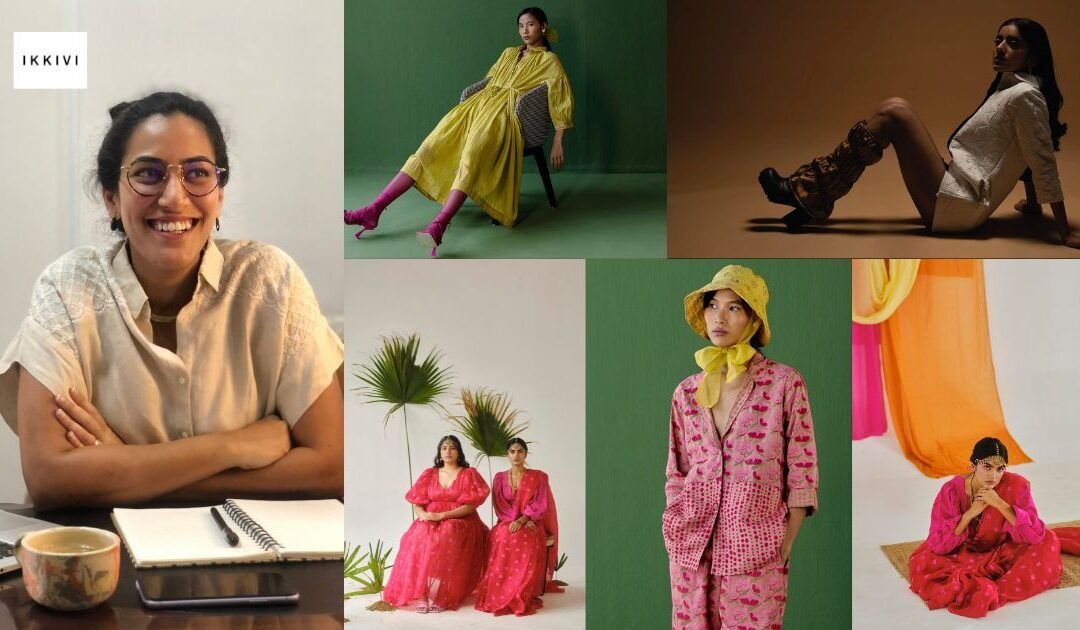
In a world where fashion is often synonymous with fast-paced trends and fleeting styles, there are passionate individuals who are reshaping the industry’s narrative. Meet Nivi Murthy, the visionary founder of IKKIVI, an online marketplace dedicated to sustainable and ethical Indian fashion. With a mission to provide a platform for talented designers who champion mindful practices, Nivi has transformed IKKIVI into a global destination that blends artistry, culture, and consciousness.
Amidst the bustling streets of the Indian fashion landscape, Nivi recognized the need for a space that showcased sustainable and ethical designs, amplifying the voices of those dedicated to making a positive impact. IKKIVI, the result of her unwavering commitment, has become a beacon of hope for designers and conscious consumers alike.
Nivi’s journey began with a profound awakening when she watched the eye-opening documentary ‘The True Cost.’ The film shed light on the dark underbelly of the fashion industry, compelling her to take action and assume a greater responsibility. No longer content with being a mere platform, Nivi and her team at IKKIVI set out to raise awareness and actively contribute to the development of sustainable and ethical fashion.
Since its inception in 2015, IKKIVI has blossomed into a trusted marketplace, connecting conscious consumers with designers who embody the values of handcrafted excellence, use of natural and organic fabrics, fair trade practices, minimal waste, utilization of traditional techniques, and a commitment to vegan fashion. The platform has recently expanded and opened their headquarters in New York. With over 45 designers on board, IKKIVI is bridging the gap between the past and the present, fusing India’s rich cultural heritage with contemporary aesthetics.
In this exclusive interview, we delve into the inspiring story behind IKKIVI and gain insights from the visionary herself. Join us as we explore Nivi Murthy’s unwavering commitment to sustainable fashion, the challenges she has faced, and the remarkable strides she has made in creating a better, more ethical future for the Indian fashion industry.
What inspired you to come up with the idea of IKKIVI?
The richness and depth of the fashion industry in India along with the talented growing number of independent contemporary designers made me want to create awareness and bring these brands to international markets.
What does sustainability in fashion mean to you as a conscious entrepreneur?
Quality, care and use for a long period of time is what sustainability means to me in the fashion industry.
IKKIVI supports more than 45 brands from India. What makes these brands stand out to be a part of IKKIVI?
Unique aesthetic, quality and their strong values.
Having run IKKIVI for more than half a decade, what do you think is the current state of conscious consumerism in comparison to the time when you had just started your journey with IKKIVI?
Yes, a lot has changed over the years. The concept of sustainability in fashion hadn’t yet reached enough people. Now, consumers are a lot more aware and are thinking twice about making purchasing decisions. We see Gen Z being more conscious with thrifting being at the helm of it all. We are seeing a lot more brands reconnecting and redefining their visions and wanting to make a change with the power they have as conscious brands. There is still a long way to go but we are headed in the right direction.
From your point of view, what is the current situation of the fashion scene in India right now?
Everyone has their eyes on India, looks like. It’s a great time to be in the fashion industry and wanting to take Indian brands international. There is more recognition and awareness beyond the stereotypes which is exciting. The amalgamation of traditional crafts and techniques with modern/international aesthetics is so beautiful and I’m excited to see that through the brands both established and young.
India is a big name when it comes to the global garments industry. But we know that the fast fashion industry still does not treat the garment workers with the fair living wage and respect that they deserve for their work. What do you think as a conscious entrepreneur needs to change?
I really appreciate the work that Fashion Revolution does with their ‘Who Made Our Clothes’ campaign. I feel such movements will put these large brands under the spotlight and scrutiny forcing them to change systemically. It is not going to be overnight but consumer awareness will increase a demand for change along with changemakers at the forefront demanding this systemic change.
Does the climate crisis affect your business? If yes, then what measures are you taking to mitigate and adapt?
I think it affects us all. As a small business we are taking small steps individually as well as creating awareness through our platforms with our community. But as an ecommerce business, our biggest footprint is shipping and packaging and we are slowly working on it step by step. First was using packaging that has the least negative impact and now we are working on grouping shipments for our international orders so as to avoid sending them individually.
What are the challenges that you had to overcome while trying to turn your incredible idea into a business?
One of the biggest challenges is finding the balance between doing business for profit and being a conscious business (and the decisions that go with it). Still something we are trying to work on.
As an entrepreneur, how do you deal with negative emotions like self-doubt, criticism, or burnout and keep yourself motivated?
A strong support system, podcasts and the innate desire to solve problems and tackle challenges.
What advice would you give to someone who is trying to become a green entrepreneur?
Take it a step at a time, there is no rush to have it all check marked the day you start. It all takes time to figure out. Start and slowly work through the aspects of being a green business. We are still a work in progress and I think progress should be given more importance and recognition.
How do you define success?
When you are able to define the way you spend your day and live it as fully as you want to
This is a part of a series where Green & Beyond Mag explores the stories and takes a peek at the lifestyles of incredible people like green entrepreneurs, innovators, climate advocates, activists, community leaders, and content creators, all around the world, who love the planet, and are working tirelessly to make the world a better place.
In a world where the delicate balance of nature teeters on the edge of collapse, Tania Roa, a passionate advocate for wildlife, environmental preservation, and social justice has emerged as a strong voice for change. With an unwavering commitment to highlighting the interconnectedness of the climate and biodiversity crises, she sheds light on the exploitation of marginalized communities and animals. Through her work, Tania emphasizes the urgent need for change and invites us to join her in the fight for a more just and sustainable world.
In this exclusive interview, we delve deep into Tania Roa’s remarkable journey, exploring her insights on the interplay between climate change, social justice, and biodiversity conservation. Get ready to be inspired and enlightened as Tania shares her vision for a future where the protection of our planet and all its inhabitants reigns supreme.
Tell us about your backstory. How did you join the climate movement?
During one of my classes in graduate school, I learned about the harmful consequences of factory farming in the U.S. for people, animals, and the environment. Migrant workers are treated as disposable and unfairly paid for their hard labor. Workers and animals often get sick or even die from the widespread use of unhygienic practices that prioritize profit over well-being. The air, water, and soil pollution that results from these practices degrades the environment and, therefore, contributes to climate change. When I learned about these connections, I realized I had found my calling: climate justice for all people and for all living beings.
As an environmental writer and speaker, you talk about biodiversity, climate change, social justice, intersectionality, and wildlife conservation. Can you please explain how all them are interrelated?
When land is destroyed for extracting natural resources, everything in the area is impacted. It’s a chain reaction that begins in the ground. The loss of soil microorganisms reduces the number of plants, which harms herbivores, and fewer herbivores signify fewer predators. This process also diminishes our ability to grow food or filter air and water. That’s why large corporations extract natural resources near historically marginalized neighborhoods – they know it’s wrong, so they strategize with the goal that it will go unnoticed. For true climate justice, we need to regenerate the Earth AND protect marginalized people.
For decades, Western conservation efforts have separated humans from nature. This mindset only leads to partial protection of the Earth, in parks or reserves that we ‘set aside’ for conservation. When we see ourselves as part of nature, this perspective shifts towards one that calls for the protection of the entire planet. Many Indigenous cultures view plants and nonhuman animals as relatives, and these are the cultures that protect 80% of today’s biodiversity. It’s not a coincidence that the way we relate to the natural world influences how we treat it, so it’s time we find our way back to nature as we did before overconsumption and over-extraction practices.
In your TEDx Talk, you discuss The Ego and The Eco mindset. For our readers, can you please explain what they are and why we need to shift to Eco from Ego?
Thank you! Ego stands for Egotistical, and it’s illustrated by a pyramid that depicts a hierarchy. Systems built on superiority are founded upon the idea that the living beings on the bottom of the pyramid are replaceable and therefore disposable. Ego includes systems that place certain humans over others based on race, class, gender, sexual orientation, etc. or systems that place people over other species.
On the other hand, Eco stands for Ecological, and it’s illustrated by a circle. When we place ourselves on the same level as all other people and living beings, we move towards collaboration. Circles are representative of cycles, and by placing ourselves in the circle of life, we recognize that what we do to others we do to ourselves. In that case, why wouldn’t we want to live in ways that are rooted in love, care, and coexistence?
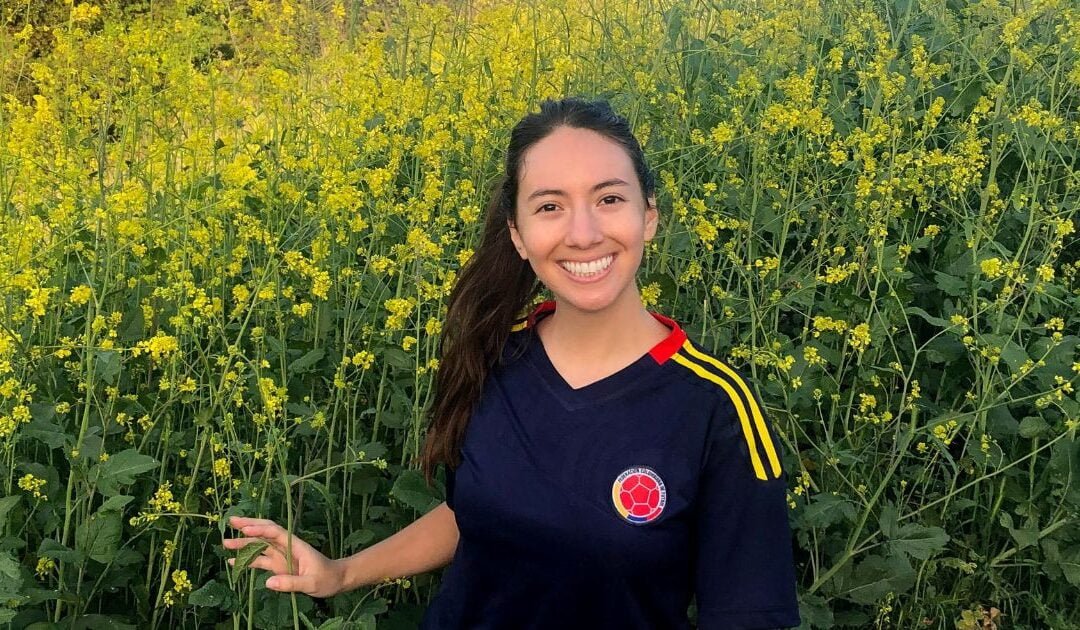
Being a Colombian-American, tell us about a practice(s) in your culture that are actually very sustainable and good for the planet.
Colombians tend to be less wasteful than Americans. In Colombia, they serve you one napkin with your meal (if they give you one at all), while in the U.S. I’ll get five napkins with my meal even if I don’t ask for any. My parents grew up learning to appreciate what you have and taking care of it so it lasts. For example, we put covers on our couches so they don’t stain as easily. I also still have the same furniture in my room as when I was ten years old, which is one way we save money.
What is your favorite Colombian food? Does climate change have any impact on it?
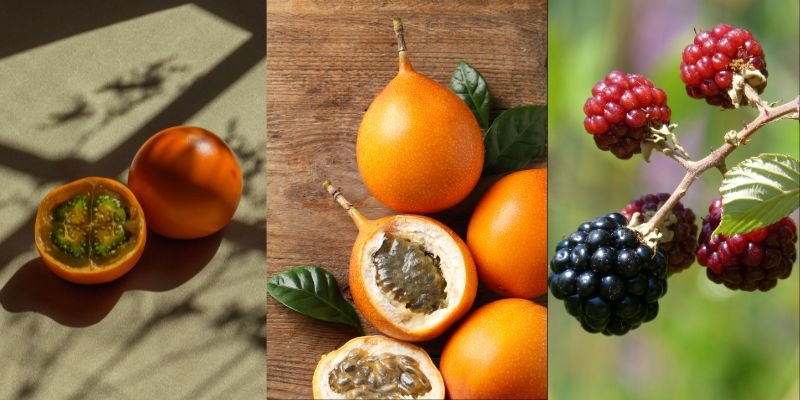
Colombian fruits are delicious. Lulo, Granadilla, and Mora are some of my favorites.
As a nation in the tropical region, Colombia’s agriculture is severely impacted by climate change. Increasing heat waves, more intense and frequent storms including cyclones, and glacier loss threaten water sources which can lead to degraded soil. One way to minimize these adverse effects is to return to Indigenous agricultural practices.
How do you practice sustainability in your regular lifestyle?
I reduce my use of single-use items by opting for reusable face wipes, a menstrual cup, and rags instead of paper towels. My mom taught me to make kitchen rags out of old towels by cutting them up. Now I adopted that mindset to my wardrobe, too, by cutting dresses I don’t wear anymore to make skirts and tank tops. My mom also taught me how to not waste food. If you ever need any ideas for how to use the last three ingredients in your fridge, I got you!
Tell us about your podcast, Closing the Gap. When and why did you start that journey?
I started Closing the Gap: a social justice podcast in February of 2022 with my best friend from high school, Adriana Medina. We’ve protested together, participated in community events, and encouraged each other to take action by signing petitions or emailing our representatives. We decided to share the resources we come across with others in a way that’s accessible and relatable, and that’s when the podcast was born. The podcast doesn’t focus only on climate, but as all of my work emphasizes – everything is connected, including social justice and the climate crisis.
What would your advice be to someone in the climate movement who feels hopeless and burned out?
Be careful where you get your news. I don’t watch the news. Instead, I stay updated with current events by following climate justice-oriented organizations, activists, or platforms that specialize in creating action items. On Instagram, Environment and The Slow Factory are great accounts to follow for ways to take action. The action item reminds me of my ability to do something – whether it’s signing a petition, donating, or calling a legislator – and that makes a difference in our world and for my mental health.
Protecting the natural world and all species that are a part of it, including humans, is my life’s work. There is no ‘finish line,’ and I don’t want there to be one. Collaborating with plants, other animals, and fungi is never-ending because our relationships with them constantly evolve – that’s the best part. I’ll continue to spread love for all living beings and speak up whenever any individual or group is disrespected.
Do you have an idol?
There’s not one person I look up to, but I am inspired by the many climate justice advocates and activists in this movement. From Francisco Activista, a young Colombian activist who encourages others to Catherine C. Flowers, author and activist who is dedicated to speaking up for poor, rural communities who are neglected by regional and national government agencies, there are people all over the world of all ages giving back to their community. Together, all of our actions add up.
What’s your mantra for life?
“When you know better, you do better.”
Maya Angelou
I love this quote because it highlights how we should all have grace for ourselves and each other. I didn’t learn about the severity of climate change until my 20s. While I wish I had begun this journey at a younger age, I didn’t know any better back then. Now that I know the problems and their solutions, I act and I ‘do better.’
Everyone has a role in the movement for a more equitable, regenerative future. My favorite resource for those who aren’t sure where to begin is Dr. Ayana Elizabeth Johnson’s Venn Diagram. Bottom line: choose something you love, and feel free to add on or change it as you grow and learn.
This is a part of a series where Green & Beyond explores the stories and takes a peek at the lifestyles of incredible people like green entrepreneurs, innovators, climate advocates, activists, community leaders, and content creators, all around the world, who love the planet, and are working tirelessly to make the world a better place.
It all starts with one breath, a pause, where you allow yourself to simply exist. When you no longer try to prove your worth and you give yourself permission to just be. That moment can seem like a lifetime – because it changes everything. It alters how you perceive the rest of your day, how you carry yourself, and how you interact with your surroundings. That’s why it’s important to take a break and try to reconnect with nature.
Today’s technologically driven world full of grind culture causes us to forget to breathe. Thankfully our bodies do it automatically, but modern society neglects the power of deep breaths. Mindful inhales and exhales do more than merely keep us alive – they rejuvenate our mind, body, and soul.
To reconnect with ourselves, we have to reconnect with the natural world. We’re part of nature, and whenever we disconnect from our breath, we disconnect from the beings that give us that breath – the plants that release oxygen, the soil that swaddles the plants, and the water that nourishes the plants.
To reconnect with nature, we can use our senses with more intention.
We limit our ability to connect when we look down at our phones rather than up, at our surroundings. As we rush through life, we forget to use all five senses – eyesight, smell, hearing, touch, and taste.
1. Eyesight:
Just looking at a landscape photo can be calming (that’s why so many devices come with nature-based wallpapers). But sight can be taken a step further: go outside and observe. Pay attention to even the slightest movement, such as the gradual fall of a leaf or the calculated journey of a snail. You’ll begin to see things you didn’t before, and that’s where you’ll find inspiration.
2. Smell:
Smell the flowers. Literally. Smell their perfumes and others, like the salt of the ocean breeze and the aroma of your tea or coffee – after all, everything we consume comes from the Earth. Smell helps ingrain memories into our brains, so let’s ingrain the delicious fragrances of our blue and green home.
3. Hearing:
Even when it’s tranquil and seemingly still, nature is constantly moving and, therefore, making continuous noise. Don’t just hear but listen to the evening calls of creek frogs as they notify you of sundown. Go underwater and listen to the crackling of busy coral cities. My mom taught me the beauty of rushing water, and now I always close my eyes to listen to the river as it seamlessly cascades over rocks and logs. These are the sounds of energy coursing through nature.
4. Touch:
Don’t be afraid to become a tree hugger. Touch is a love language, and what our planet needs right now is more love. When we interact with the natural world, we act out our admiration for it. Respectfully demonstrate your affection as you would to a loved one.
5. Taste:
Taste the sweetness of the Earth. Everything we eat comes from soils or oceans. No matter how many artificial ingredients we add, everything edible originates from the planet. So why not taste all the elements? Gather food as close to its source as possible by supporting local small-scale farmers or growing your own food.
When we unwrap the potential of our five senses, we gain an understanding of our place in nature. Daily tasks become meditations. A walk at the park evolves into a vibrant journey when you observe, smell the plants, listen to the birds sing, touch the grass with your bare feet, and taste the juiciness of ripe fruit.
Let’s rebuild our relationships with the beings that give us life.
Growing up in Kenya, Rahmina Paullete, young climate activist, environmentalist, and wildlife conservationist started her own organization called Kisumu Environmental Champs to bring together environmentally conscious youth to inspire collective action for the planet back in 2020 while she also runs her own sustainable business. Looking at all the sufferings that her people are facing in the Lake Victoria region, Rahmina decided to speak up and take action to help restore the ecosystem of Lake Victoria, the largest lake in Africa.
Tell us about your backstory. How did you join the climate movement and become a climate activist?
I have been an environmentalist almost all my life since I was 5 years old, but I have now become a climate activist because I realized that the actions that we are demanding are not being taken seriously by the government, the community, and especially by the private sector – the multinational companies.
So, back in 2021, I started demanding change for us, for our future, especially in the Lake Victoria region. This was mainly inspired by the climate crisis impacts that we have faced for the past years – like the rising of the water level of lake Victoria and how it has affected the community and the biodiversity.
Source: www.rahminapaullete.com
What motivated you to start Kisumu Environmental Champs?
I started Kisumu Environmental Champs back in 2020 during the outbreak of Covid-19. So I came up with the idea of having a group of environmentally conscious people, especially young people, mainly students. I thought, maybe at this time, when schools are closed, students can take the time to bring in the changes in the community and act with the purpose of enlightening people on environmental conservation and the urgent need of creating climate solutions. Now we have many students, youths, and also parents in the organization.
Besides being a climate activist and an entrepreneur, you also focus on sustainable living. So how can anyone start living sustainably? What’s the formula?
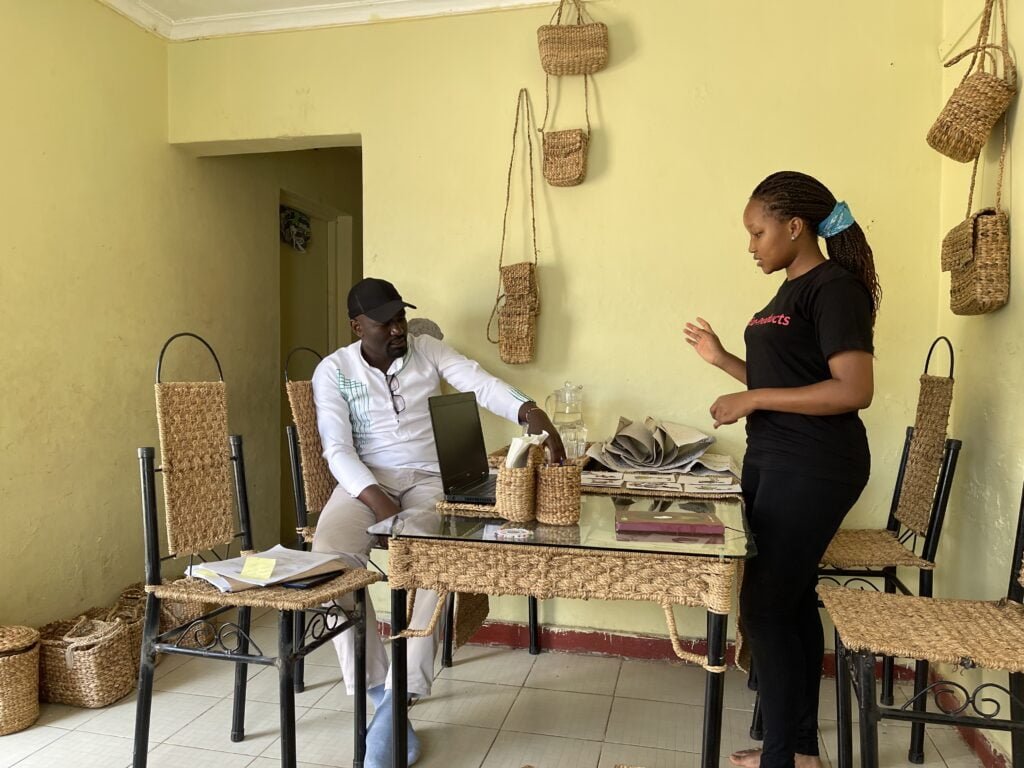
Well for me, I believe in small steps. I mostly buy second-hand clothes. I know that people from all parts of the continent of Africa buy second-hand clothes very often. Apart from that, to reduce plastic waste, I always carry my water hyacinth bag. Also in our house, we have a little kitchen garden where we usually use our food waste as compost. So, in a nutshell, I always keep emissions of greenhouse gas and pollution in my mind and I try to act accordingly, no matter what I do.
Tell us about your sustainable business. Do you plan to give it a more formal outlook in the future?
It’s a funny story that actually made me come up with this sustainable project. So the story is from back in 2016. I had just come back home from the lake where I went with my mom for boat riding – because I love boat riding. But sadly, that day we were told by one of the boatmen that we could not go on a boat ride. So I was really sad when I got back home as I had nothing to do. So, then I just had an urge to look up water hyacinths and found out that they can be reused and beautiful products can be made from them.
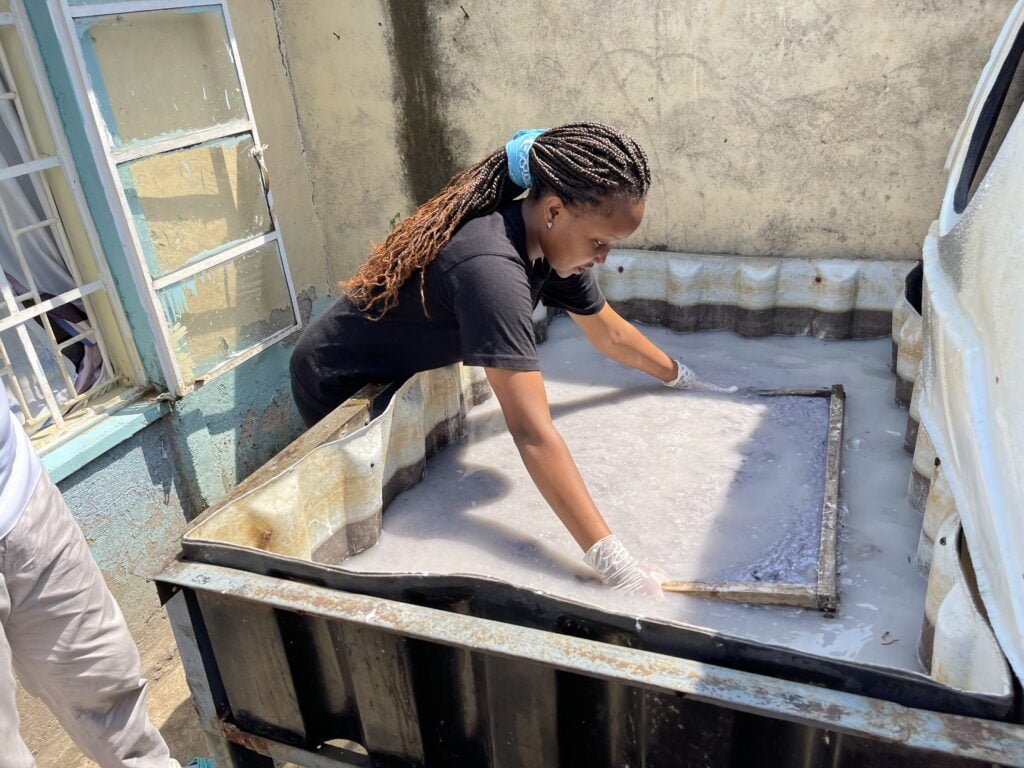
So it started off as a project where we were making papers and cards, but then, we actually realized that we were just limiting the production so we expanded into a small business called “Rahmina Paullete Eco-Products”. So that is when we started making eco-friendly products from that. Right now, we’re looking towards expanding the business, in terms of increasing the production, and having more machines. So I guess I can say that the outlook towards the future for the business is to bring more sustainable products.
Source: www.rahminapaullete.com
Tell us about some sustainable practices in your culture.
In my culture, we normally eat indigenous vegetables – which not only has medicinal properties but is also very sustainable and climate-friendly. Then, originally before our culture became vastly westernized, we used to wear clothes made from nature, like cow leather – just creative wears made from things like animal skins and plants like Sisal. Although it is something that we still occasionally do, most people do not wear that normally anymore. So that was actually one of the ways for us to live sustainably. We also used to have bags made of Sisal. These practices have been passed from generations to generations and that’s how the knowledge was preserved.
How do you keep yourself motivated and keep doing what you do while dealing with negative emotions like eco-anxiety?
I do suffer from climate anxiety due to the impacts of the climate crisis like floods, the environmental degradation and pollution. But these things also motivate me to see a vision for my people from the Lake Victoria region where they can swim in the lake without facing any irritation to their skin, where there are plenty of indigenous fishes in our lake, where there is no pollution, how our ancestors saw it. These are the things that make me want to take action to help restore the ecosystem of Lake Victoria.
Normally when I face negative emotions, I like to visit places that are peaceful that can help me to connect with nature. Sometimes I go to Kisumu Impala Park to look at wild animals. Also, music helps me a lot to overcome my negative-emotions.
What would your advice be to someone in the climate movement who feels hopeless and burned out?
Well, I would advise them to continue their work. I know it can be tough but it’s important to know that the combined result of our efforts, no matter how small they are, can create bigger impacts towards restoring ecosystems and make our planet a better place.
Do you have an idol?
For me, I can’t say that I have an idol. I’m not really looking up to anyone, but I am currently following the steps of people such as the late Wangari Maathai. I also follow the steps of my mentor, Paulene who is actually an agronomist and a specialist in climate change adaptation. I also have someone who I look up to who is called Kevin Mtai, who is the founder of Kenya Environmental Action Network (KEAN) and also a climate activist.
What do you do for fun? Any hobbies or passions?
For my hobby, I love going on boat rides. Apart from that, I love listening to music and also singing this song called “Save The World” by Jarvis Smith. That’s my favorite song.
What’s your mantra for life?
Change starts with us, for us and by us. We can make a change in a span of five minutes and it should reflect on the future to come.
How can others join you in the climate movement?
Well, it could be in different ways. One, someone can join the movement through Kisumu Environmental Champions. Or even by supporting our campaign that we are running to restore the ecosystem of Lake Victoria which is #LetLakeVictoriaBreatheAgain.
So people can join the campaign by sharing a one minute video talking about Lake Victoria and the urgent need of restoring its ecosystem. That will really empower the indigenous community. People can also join the campaign by doing cleanups and they could help us financially which will help us bring resources since we need a boat for the Lake Victoria cleanups and removing the water hyacinths – because boats can be quite expensive. If we have our own boats, we can go from Kenya to Uganda and Tanzania for advocacy. Apart from that, I think financial support will really help in terms of getting us tools for cleanups and transportation for people. So, I think that would be amazing but in case they also want to join Kisumu Environmental Champions, we are open and glad to welcome anyone to join us.
Where can people find you if they want to get in touch with you or follow what you’re doing?
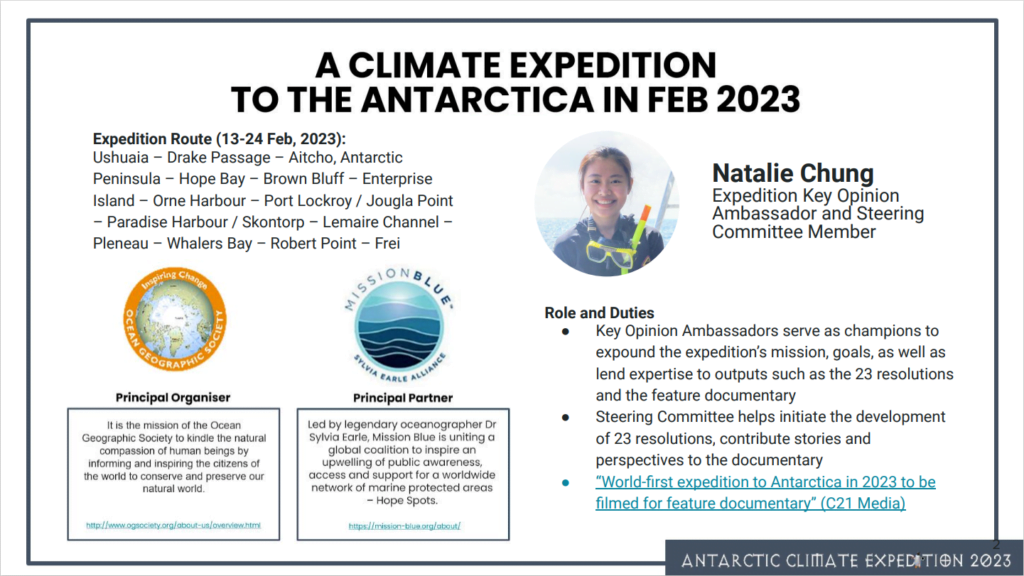
Natalie Chung, a young social entrepreneur, environmentalist, and sustainability leader from Hong Kong has been selected to represent her country at the Dr Sylvia Earle Antarctic Climate Expedition 2023. At only 18, Natalie co-founded her social enterprise, “V’air” back in 2015 to promote low-carbon local tourism, i.e. ecotourism as a means to mitigate climate change. As a remarkably impactful sustainability leader in Asia Pacific, she has been awarded the Tatler Gen.T List, Eco-Business Youth A-List, and was recognized by The Japan Times as a female climate activist driving change in Asia.
Now, as she prepares to represent her country at the Dr Sylvia Earle Antarctic Climate Expedition 2023, let’s take a closer look at how she practices sustainability in her regular lifestyle and how she plans on creating a long-term impact through the upcoming expedition.
Tell us about the expedition.
I will be going on the Dr Sylvia Earle Antarctic Climate Expeditionin February 2023. The mission of the expedition is to formulate 23 net zero solutions to accelerate carbon neutrality by the year 2035. This is currently our ambitious goal and our central message is actually to highlight the role of the Ocean in climate change mitigation, adaptation, and resilience because we think the ocean is a big missing piece in the puzzle and a lot of people only focus on land-based solutions when it comes to climate change while in a lot of countries in Asia, we’re actually very vulnerable to sea level rise and ocean acidification, which are accelerated by climate change. So, hopefully this expedition will shed light on some of the ocean-based solutions and how the communities can develop solutions that are both innovative and able to help us transition to net zero.
On the expedition, there will be a mix of crew members and ambassadors from various backgrounds and disciplines. We’re hoping to generate some interdisciplinary discussions and solutions. I’m a climate activist myself, from Hong Kong and there are people from the UN Network, IUCN, professors, and researchers from different fields. There are also writers, artists, and of course, underwater photographers. We have two National Geographic underwater photographers, Jennifer Hayes and David Doubilet, who will be capturing some of the photographs that will be used later for our exhibition around the world.
So the expedition itself would be a nine-day voyage and for the first two days we will have a small conference at Ushuaia, Argentina to formulate the resolutions. And then the final day, we will also have a day in Punta Arenas, Chile to post a conference on the resolution and how to carry them out to action steps on the ground, and how all the participants in the expedition can bring back these solutions, back to their home countries to spread the news and see how to implement them in the community.
How does it feel to be a part of the expedition team of Dr Sylvia Earle, who was recognized as the First Hero of the Planet by Time Magazine?
I feel very star-struck because Dr Sylvia Earle was always a role model for me. What she’s done for ocean conservation and as one of the pioneers in space, and we call her “Her Deepness” instead of Her Highness, for how deep she has traveled down the sea. So I think it’s a very precious opportunity. We did have some air time before, at virtual conferences. So, I once spoke with her and listened to her remark, which is absolutely inspiring.
And this time, what’s even more exciting is that the ship that we are boarding is also named after Dr Sylvia Earle. It is a new cruise ship for the expedition that is carbon-neutral. We will also be celebrating Dr Sylvia Earle’s work. So it’s very interesting. This ship will be on its first mission. But it will probably be Dr Sylvia Earle’s last expedition because she’s getting old.
So I think it will be a great platform and opportunity for a lot of youth and older generations to come together to form intergenerational climate solutions that will be inclusive and equitable for all. Because – I think the youngest on board would be eleven years old and the oldest would be like 90. So it’s a huge range and I’m very excited to be there.
But at the same time, I think, there is a huge responsibility for me to make full use of this, for example, by forming partnerships with different media outlets and especially with a focus on Asia, because most of the people on board, I would say, come from the Global North. And we need to make sure that the solutions are centered around the needs of indigenous people, and the underprivileged communities in global South and Southeast Asia as well. So, hopefully our discussion will be more inclusive by bringing in perspectives from Asia and the rest of the world.
How do you plan to add value to the expedition with your expertise in the areas of public education, corporate training, and media and communication?
My role in the expedition is the Key Opinion Ambassador. There are a total of around 30 of us and I think what differentiates us from the rest of the expeditions is that we are already doing monthly meetings on the resolution. So we’re kind of forming the backbone for the 23 goals that we will finalize on the expedition. Now we’re using the Delphi method. It’s like a social science methodology based on expert elicitation and literature review to try to find a consensus on what direction of solutions we are coming towards. So we’re having monthly meetings on these to formulate the expedition goals.
And then for me, I’m the only Hong Kong representative for this entire expedition. So I think I will play the role of bringing in some of the localized knowledge and also solutions back to Hong Kong, given that we have quite rich financial resources that we could mobilize and some of the corporate partners in Hong Kong that would be able to do something at scale. So hopefully after the expedition, I could use the findings to convince some of the major business leaders and political leaders here to implement solutions. That could not just benefit Hong Kong but also the rest of the world. For example, Hong Kong has a climate-resilient infrastructure, and how we can export these technologies and skills to the rest of the world and showcase our best practices. So I think I would ask this bridge throughout this expedition to amplify the impact.
How can media play an important role to raise awareness and help overcome the climate crisis by reaching the Net Zero Target by 2035?
I think the media can take a role in the whole communication strategy of the expedition. We want to focus on people who are very alarmed and concerned about climate change, people who already have some knowledge and want to act against climate change but they don’t know how or don’t know the full set of solutions yet. So I think for us as our focus is on Ocean, and the role of the Ocean, I think the media could help shape the narrative for – why is it so important to represent Ocean, the media can help to create the whole momentum around ocean which is so crucial for climate action, adaptations, resilient and livelihood, and how we can tie in the Antarctic narratives with some of the phenomena, we see in Asia. Because I think the Antarctic is at the forefront of climate change, they are warming at an alarming speed. They’ve already warmed three degrees celsius since I think they’re like pre-industrial age. So I think we can create/ consider the Antarctic as a model of what the future would look like if we continue this warming truck and then use the power of the media to paint that scenario. So that we can all feel the sense of urgency, at the same time the power to act. Because we know that the ocean is immense and there are so many potential solutions in the ocean that we have not yet fully explored.
You’re the co-founder of V’air. Tell us about the platform.
So we started up V’air back in 2015 as an organization to promote low-carbon, local tourism. The reason is just that, we figured that almost 20% of Hong Kong people’s per capita carbon emissions come from flying overseas. So, during pre-covid times, we used to fly a lot of short trips to Japan, Korea, Taiwan just for for weekend getaways. This issue was kind of not that elevated back in 2015 like now when most people are focusing on some of the energy-saving measures for climate change. So, I wanted to bring this back to the table, like – if there was an elephant in the room, when people said, “Oh I’m not using a plastic bottle but I’m flying like 10 times a year.” So I want to correct this by showing people the potential of local tourism – it’s actually eco-tourism and geological tourism. That’s how we started. And we have a web platform to showcase these attractions in Hong Kong. We also published a book showcasing 39 roots in rural and urban areas, so the book is like a guide to travel around locally. We also organized eco-tours for schools and corporations – introducing them to different tree species, special endemic insects, and mammal species in Hong Kong as a form of nature education. We realized that quite a lot of people enjoy hiking a lot, but they wouldn’t pay attention to the trees or they would not pay attention to the story behind the trail. So we think there’s immense value in doing that – kind of sparking that interest and curiosity in their surroundings so that they don’t always need to go abroad in order to find excitement or find a thrill.
How are you expecting to integrate your work at V’air into this Expedition?
I was actually planning, after the expedition, we would create more tours around marine protected areas. Because one of the preliminary resolutions that we have touched on in our current discussions, one of the goals would be enhancing marine protected areas globally. In Hong Kong at least 3% of the ocean is protected but we want to raise that to 10% which is the global standard. We could also be hosting more ocean-themed eco-tours. Because currently, we have a lot of land-based tours like terrestrial country parks, and some of the rock formations but not so much in the sea or near the shore. So that’s what I’m planning to do.
Also, another way to integrate is, how we’re training the next generation of young leaders. So in Hong Kong, we have our internship and fellowship program. So, in the past few years, we have already trained over 100 youths and sparked an interest in sustainability and climate advocacy. I’m hoping through the expedition, I will be able to learn from some of the other famous educators on board and see how we can make or copy our existing model elsewhere, like in other Asian countries or how we can collaborate with different partners to extend our impact.
Another thing I would like to try is to expand to other regions. We tried to expand to Singapore before but there was a bit of difficulty and also Covid restrictions. So now we’re looking into mainland China opportunities so that our target group could be bigger. I guess it’s not enough for the Hong Kong people to stay in Hong Kong. Maybe we need to give them more options, for example, taking high-speed trains from China to Russia, which is also a low-carbon mode of tourism. There’s this Siberian train track, so maybe that could be an option, also low-carbon. Because it feels very restrictive to have everyone stay here. We want to keep the experience educational but also entertaining. So we’re looking at some of the high-speed rails as travel options. And then, you can also apply to other places like India. I guess in India, there are lots of ecological hotspots that local people may not pay much attention to. So simply encouraging more people to travel, from South India to North India, could reduce outbound travel and harm to the planet.
You promote eco-tourism through V’air. How is this expedition aiming to promote eco-tourism?
I have actually had a lot of self-reflection on whether I should join the expedition because I was wondering if what I’m doing – like joining the expedition, could cover my carbon footprint. So, first of all, we will be offsetting the whole expedition ensuring all the operations are as low carbon as possible, for example, we have vegan meals on this ship and we’re ditching single-use plastic, etc. Another important thing is, how we are shaping the narrative to ensure that it’s not promoting exploitative tourism to the Antarctic. Because people have previously treated it as a leisure option and not just for research purposes, a lot of people go there just to see the penguins, like a once-in-a-lifetime opportunity. So, we actually do not especially encourage that, but then we don’t want to be too ironic about how we have the privilege to go but other people don’t. So I think we are planning to work on a more immersive educational experience, such as, we are introducing VR so that we can take some VR video clips for people in different places to experience it without having to travel there. And I guess the future of tourism, even eco-tourism would be more of a hybrid reality experience – like how we are integrating some tech elements into the tourist experience and using different senses to feel like having meditation and wellness integrated. Therefore I think, it is important to have that narrative or have that note in mind that we are a very privileged group of people who are able to go there firsthand. And how we are translating these first-hand experiences into something valuable for people to experience second-hand would be the key and the goal for us.
Why do you think raising awareness, especially among young people is necessary?
I think young people play a crucial role in shaping the future because eventually, we are the ones who will be the steward of the planet in the future. So what we are deciding now and what we are proposing now will potentially shape how we live and how habitable the planet becomes. So I think it is definitely important to hear and listen and use voice in policy making and have a system that can institutionalize our thoughts into actual policy and decision-making processes instead of a tokenized form of youth participation.
And in this case, I think for the expedition we are hoping to come up with the 23 high-level goals, but eventually, we want to come up with action steps beneath the goals. So, for example, one of the goals could be promoting less consumption of seafood. Because it promotes sustainable fisheries and also protects ocean resources.
And then on action steps, we can translate it to youth by organizing some youth campaigns, or incorporating this into part of the syllabus so that they can understand at a young age what’s the issue with consuming too much seafood and how we can select wisely what to eat. I think incorporating that into the educational curriculum is the best way to ensure that we know from a young age, what is the right action to take for a planet that we would like to see in the future. Also, another thing is how culture and values are created and are kind of formulated at a young age – like once you are structuring your value system, it’s important to have that intervention on what’s the most ideal or sustainable way of living. So I think that’s also why I really think it’s important to focus on nature education. Because when you bring people up to nature, they get to understand why it’s so important to conserve it rather than educate them afterward to pick up their trash, to not do this and not do that. So I think building that kind of intrinsic human nature relationship from a young age is crucial as part of our youth development training for climate action.
We’ve noticed that you’re a keen follower of sustainable fashion. How did that journey start?
Actually, I haven’t really purchased clothes since I was young. Because my mother works as a fashion manufacturer and she always has a lot of samples and some of the defective items that she would just bring home and we’d just wear them. I guess her job experience shows me how disruptive the fashion industry is, given that they’re throwing away so many clothes she tries to bring as many as possible back home, but then the rest will still be thrown away. And so, from a young age, I realized this problem of fast fashion and what we can do as individuals to counter it. I was lucky enough that I didn’t have to buy anything because my mother would give it to me. But now, as I grow older, I still need to shop on my own. So, then I will opt for thrifting second-hand clothes. I think I kind of started to experience the joy of thrifting when I was in the United States for exchange studies and saw a lot of thrift shops. In Hong Kong, it’s not as common to find these thrift shops, as most of the thrift shops are relatively low-end – very, very cheap fashion or fake items. So, it wasn’t very encouraging to go there. But then, a few years ago, I came across a new foundation in Hong Kong called Redress and I really appreciate their work. It’s run by 3 to 5 people – a small team but they’re collecting a lot of relatively higher quality secondhand clothes, and then they sell them. They rent a space in an A-grade office building and host a Second-hand Gala for everyone to buy these clothes at a cheaper price. I’ve become a fan of that Gala and I really appreciate how this is becoming a trendy thing to do – to wear secondhand items. I hope this will continue in the future.
I guess the most important thing is to destigmatize wearing second-hand. Because when I go to more high-end places and I tell people that I’m wearing second-hand, they might still think lowly of me. I think we just need to detach the idea of wearing second-hand from being cheap because it’s actually regenerative and positive for the planet. So I’m actively trying to shape this narrative by being proud of wearing second-hand and also encouraging more of my friends to change into this new lifestyle.
Do you go through eco-anxiety? If you do, how do you deal with it?
I guess for me, I haven’t really experienced true eco-anxiety, unlike some of my friends. I guess it’s because I’m living in a relatively privileged city, so I don’t feel the immediate impact of climate change on our community. I do feel sad seeing all these negative things happening around the world. We need to be even stronger and even more confident in trying to solve it from the perspective of mitigation to adaptation. I think seeing all these extreme events, my attention is shifting more from the mitigation side to the adaptation side, because I think, for mitigation, it kind of seems like some of the solutions are natural because there are financial benefits to do so, like people are investing in renewables because it just makes sense. But for adaptation, it’s always about loss and damage, it’s always about compensation. There’s no natural motivation to push adaptation projects to be realized. So, personally, although I haven’t felt eco-anxiety, I just feel a stronger urge to work on climate adaptation and see what we can do to make these impoverished communities live better and even for resilience – like how do we build resilience in that infrastructure in community networks. So that we can prevent damage to them when future events hit.
Tell us about a practice(s) in your culture that’s actually very sustainable and good for the planet.
I guess it’s the rice dumplings, like, for Dragon Boat Festival, we will wrap rice with banana leaves and then we tie it with a string made from seagrass. So it’s a natural way of making our delicacies.
How do you practice sustainability in your regular lifestyle?
I think I’m very cautious of what I do and what I admit, for example, for travel, I would try to aggregate my tours as far as possible. Then I wouldn’t need to travel too many times a year, even for important events. Then, of course, I don’t use any single-use plastic, so I never buy drinks outside. I would always only drink water most of the time. Or, maybe if I really need, I get aluminum canned drinks so we can recycle the cans. For fashion, as I mentioned before, I always follow slow fashion, and I even buy my furniture and other items from second-hand marketplaces. For makeup, I use vegan and cruelty-free brands. I’m a pescetarian and I’m moving toward becoming a vegetarian or vegan, but I’m still struggling with some of the nutritional requirements for myself. So I guess, my advice would be to do what you’re best at and to pursue that.
I’ve also learned over the years to not stigmatize people. Like, I used to discriminate against everyone who used plastic bottled water but then when you think about it, maybe they never take a flight, or maybe they’re very sustainable with their diets. So I think everyone can play that part and support others because everyone doing things, even if it’s something little – would mean a lot to the whole world.
What do you do for fun?
I love hiking because it is a good way to connect with nature and also with the local villages, especially going to the snack shops selling local food, like tea cakes along hiking trails.
I was actually inspired back in primary school when I did a project on climate change and we interviewed a polar explorer called Dr Rebecca Lee. She’s the first woman in the world who has traveled to the North Pole, the South Pole, and Mount Everest. So she’s my absolute idol.
And now I am very honored to be able to go on this expedition and hopefully I can bring as much impact to the world as she did because she inspired me just by having one interview. And I hope that I can also speak to someone and inspire them to be an advocate for the climate.
What’s your mantra for life?
I think it’s that – change starts with ordinary people doing extraordinary things. I always think that change doesn’t need to start with something very grand but just as my idea would evolve into something that is material if you work hard enough and there’ll be people supporting you along the way. So when I first started V’air, it was completely out of the blue – we had just joined a competition and had this idea and then we decided to continue it – just because we really believed in the mission. And then we met quite a few important mentors along the way, who advised us to keep going and introduced us to business partners so that we could grow and scale up till today. So, I think, we need to believe in ourselves and our capability to do something bigger than ourselves.
I think the best way is to just reach out to me if you’re interested in starting a regional chapter of Vair, like just the same idea of promoting local tourism in your locality. And we can share some resources with you to start the organization in your country or city and even with some startup funding that we’re able to raise here in Hong Kong. So if you want to do something in Bangladesh, for instance, and you’re looking for somewhere to start, we can potentially give you some grants to start it locally so that we can expand our impact.
For other things, you can stay tuned with my social media and I’ll be posting some of the channels through which other people can participate in the Antarctic Climate Expedition. Because I think during and after the expedition, we’re planning some idea co-creation rounds where we’ll be doing virtual webinars and brainstorming sessions that everyone can join in forming part of the resolutions for Net Zero and potentially some of the submissions we make to the UN and National governments.
Growing up on the central coast of California, Jessica Vetterli developed a deep passion for the enjoyment and protection of nature, a passion that would stay with her throughout her life.
As a young adult, she took up the cause of the environment, working in grassroots campaigning for Environment California, implementing a refill program at an olive oil chain and founding and growing a zero waste granola business in the Bay Area. After receiving a B.A. in Sociology from the University of California at Berkeley in 2013, she went on to join Seed Consulting Group, a firm dedicated to solving complex business challenges for environmental non-profits. But she knew that she wanted to do more, to have a bigger impact on the world. And so in January 2021, she founded Simply Sustainable, a sustainability consultancy for individuals and innovative CPG brands to reach their full potential in creating value for the planet and people.
Tell us your backstory. What inspired you to start Simply Sustainable?
So I grew up in California, – and being a Millennial, I grew up in the generation before phones and social media were a big thing. So, my entire childhood was really in nature – we were always outdoors camping, hiking, and we lived right by the beach, so we were always swimming, surfing, biking – we were always doing something in nature. And I feel like from an early age, I had this connection to nature on a deep level and I think I just kind of took it for granted. I was like “Oh, this is how it is. This is how everyone is.” But then, I got to college and learned about climate change and its consequences that humans are facing. And also the fact that it’s actually human-induced – like we’re creating it! And I feel like in my mind, I was just like, “This doesn’t make any sense. Why are we destroying our home?”
It made me really sad to think that, generations after me won’t be able to experience the same joy and bliss that I found in nature. So I wanted to align my actions and my career with the environment because, as humans, we have that self-awareness and that’s something that differentiates us from other species. It’s like, we can actually enjoy nature, appreciate it, and have that sense of awe and wonder.
And it’s like I’m seeing the effects of climate change now. Even in California, it’s not the same as it used to be – all the wildfires that have been happening over the past few years – they’re getting worse and worse every year and I see how it affects my family and friends that live there. I’ve had friends that have been displaced from their homes, they had to evacuate because the fires are so bad and the drought is so bad. But when I was growing up, that wasn’t a thing – no one talked about that, no one worried about that. California wasn’t like that, you know? Whenever I was asked “What do you think about California? I’d be like, “Oh my God, the beaches and palm trees! It’s so beautiful.” That’s how it was. But I feel like now, California is experiencing terrible, terrible consequences of climate change. So I guess, kind of coming full circle, that was kind of the reason why I started caring about climate change and helping the environment.
I’ve learned so much in the past two decades about sustainable living and what that means – like switching over all my lifestyle habits and just really getting involved locally and within my community and also on a bigger basis. So, that’s really what inspired me to start it.
Mornings are my favorite time of the day, it’s like that sacred time for me, where I try not to check my phone, I try to just have that me- time. I usually make coffee and breakfast and then try to get some movement before starting the day. So I usually try to go for a run or go to the gym or just yoga because I have a lot of anxious energy that I need to let out first thing. And then after, I’ll usually start meetings and have a full day of work and then on a good day, I’ll try to finish work around 7:00 p.m. And then after that, I’ll try to do something social – like, go see a friend, or go to a show or a movie or something.
Because in New York, there are endless opportunities to do things. So, it’s hard to balance work and self-care besides two jobs and also trying to have a life.
How do you practice sustainability in your regular lifestyle?
I would say sustainability – it’s really integrated into my everyday life, to the point where it’s so automated now that I don’t even think about it – it’s like brushing my teeth – kind of a thing. And that’s really what I’m trying to help my clients achieve through Simply Sustainable. Since I’ve been learning about sustainability and really trying to make those lifestyle changes for like two decades – which makes me sound old (chuckles) but, fun fact I’ve never actually had a driver’s license. So, I’ve never owned a car. Never. I mean I’ve ‘driven’, technically like once in a while in my life but I do not drive. I 100% use public transportation and walking for everything. Luckily, I live in New York City, which has amazing public transportation. So taking the subway, biking, that’s a big thing.
I have made it a point to understand my local municipality center – what I can and cannot recycle, how to compost and just overall how to reduce my trash. So, I really don’t produce a lot of trash and I live pretty close to a zero waste lifestyle. And I’m very fortunate in that sense, because I have access to a lot of resources. I get that being able to live a zero-waste lifestyle is really different depending on where you live. So, some people don’t have access to bulk stores or reusable stores and things like that. So of course, I totally understand that. So, recognizing my own privilege, and being able to live in a community that supports that.
I took a tour of New York City Recycling Center, it’s called Sims Recycling Center and actually it was super enlightening because they really shared what New Yorkers can actually recycle and can’t. A lot of people think they know what’s recyclable and they’ll just throw something in the bin and hope that it’s recyclable, but they don’t really know. And so when I took a tour of the recycling center, they really broke it down there like, New York city cannot recycle flexible packaging, it cannot recycle cardboard that has oil on it, etc. – so they really broke it down. And it made me understand exactly what I can recycle and what I can’t recycle which has also influenced the way that I make purchasing decisions. So when I’m at the store and I buy things, I think about the package and I really try to prioritize buying things that I know have a high recycling rate in New York city. So, that’s one thing. And then, composting is super important to me and it’s something I really enjoy. I feel like there’s something about being around food scraps, it just kind of feels like it connects me to nature.
Also, I buy used items whenever possible. I really try not to buy a lot of things. I’m not very materialistic, I’m very minimal. So I really just try not to buy a lot in general, but if I do, I really prioritize buying used items. For example, when I moved into this studio apartment, I had never lived on my own before. So I had to furnish my apartment. I had to buy a table, a couch – all that stuff and I went to local used marketplaces for all of that stuff and I was able to find everything I needed. And it was pretty cool because I was able to actually talk to the real people that owned them and I could hear their stories. Like, I have this beautiful table and the person was like – “This table has been in our family for like 20 years. I’m so happy to pass it on to you.” So everything that I own kind of has a story to it.
Lately I’ve also been thinking about anything that I buy or that I’m going to bring into my home. I try to always challenge myself to ask that question like – “Okay, I want to buy something new but let me think about it, do I see myself having this forever?”. I try to think about the life cycle of the product or whatever it is I’m buying. And then, if I do buy new, of course, I really try to prioritize buying from sustainable companies, like ethical businesses that are local of course.
I have a plant-based diet, I’m also really passionate about that and my friends are down too. Like, they always want to try vegan restaurants with me – which is really cool. And then, I started this business as I really want to help other people that don’t necessarily have the knowledge or time or energy to figure out all these things for themselves. So, that’s kind of a way that I’m trying to go above and beyond with my own individual life and really make a broader impact and help others.
What were the Eco traveling preparations and experiences like on your recent trip to Italy?
I think with traveling, it’s definitely a tricky issue. And as I mentioned, I’ve never had a car. So, first of all, I do try to be mindful when I travel. I try to really think about “Okay, do I need to go on this trip? How will it enrich my life overall?” And so, when I went to Europe this summer, one thing that I do want when I travel is that I try to just travel from one place and not hop around too much – I try to stay in one place and travel deeper, rather than broad. I used to do backpacking, which is cool, but these days, I want experience. Like, I’d rather stay in one city for a month, than travel to five countries because, that way, you get a deeper experience of the culture.
So, I went to Europe for three months and I primarily lived in Paris – that was my home base. And, Paris is a huge metropolitan city just like New York. So, I was able to take public transportation, I was able to incorporate all of the lifestyle habits that I have in New York and I was able to do that really easily in Paris. Also, when I travel, I try to do research on where I’m going and see, “Okay, do they have public transportation? How can I compost there? How can I recycle there? Are there any zero-waste stores that I should check out? Any vegan restaurants?”
So if I’m going to be there for a long time, I try to do research on that place and see how I could be sustainable while there. So Paris was great, and I was really there for three months. I mean, I could have traveled all over Europe, and I met people that were traveling just like me and they were going everywhere – they’re taking planes from here and there, like all over the continent because it’s so cheap. But I’ve only been out of Paris twice – one time, it was Italy – to meet one of my co-founders for Simply Sustainable, and then the other time was Croatia. So within that whole time, I only traveled twice outside of Paris. So, it kind of gave me that deeper experience of where I was.
And then, when I travel I try to stay close to my zero waste lifestyle – like still bringing in my containers and trying to be mindful of that.
As an entrepreneur, how do you deal with negative emotions like self-doubt, criticism or burnout and keep yourself motivated?
I would say it’s a process. I definitely don’t have it all figured out, it’s something that I am continuously working on every single day. One thing that has helped me is reflecting back on the past.
So, when I was in California after college, I had another business. It was a zero-waste granola business. So, I was doing that for a few years and it was such a beautiful experience, it was amazing. And I reflect back on it these days and think “Wow, that was so cool” and it really resonated with a lot of people and it was something that even to this day I don’t even see – like no one else is doing it.
Basically, I had this business where I was making granola and I was selling it all in reusable containers and bulk containers. So every store that I was selling it to and that I would partner with, I would implement this circular system which was a part of my brand and I was like “Hey guys, here’s this really amazing granola. Bring in your jars or I have a jar for you. You can save it and bring it back for a refill.” So it was like a circular model and it was pretty cool. Like I said, to this day, I still don’t even see that a lot. But at the time, when I was doing it, I faced a lot of self-doubt and I was always questioning myself. I was always asking “Why am I making granola? Is this really what I want to do with my life?” I was questioning everything and it held me back a lot. So, that has been an insightful thing to think about. Because I look back at that experience when I was doing something pretty cool but I still had so much self-doubt. So, with my new business, Simply Sustainable, I still face those same inner criticisms and I question myself like, “Oh my God, is anyone going to want this? What am I doing? Should I just stick to a day job?” – all these kinds of things. I try to look back on my previous experience and think, “Oh well I was asking myself the same questions, so it’s really not about what I’m doing, and it’s more about me – like it’s something that I need to work through.”
Another thing that’s helped me is trying to look at my business objectively. I think when we start our own businesses, everything feels so personal to us. Like our success feels personal, and if we get rejected from a client or from someone important, that feels personal too and it feels like, “Oh we’re a failure!”
And one thing that’s helped me is really trying to separate that. I have this full-time job also, right? And it’s funny that I never feel self-doubt in my full-time job – like I just go for it. I don’t care if I fail, because I’m like “Oh well, I still get a salary.” And I work in sales, so when people reject me, I’m like “Oh, it’s fine.” I don’t care because this is just part of the job. So I try to apply that thinking to my own business. But for some reason, it’s harder to do so with my own business because it feels more personal. But I try to be objective and think like, let’s say, I just got hired to do this business. Let’s say it wasn’t my idea, I didn’t create it, but someone just hired me, saying “Hey, sell Simply Sustainable, or build Simply Sustainable.” I would have approached it and thought about it so much differently. So that’s been a good thought exercise for me.
Basically, I wanted to move to New York and it was just a lot of doubt honestly. At the time, I was in California and I was like, “I don’t know if I just want to have a granola business forever. I don’t know if this is actually what I want to do with my career.” And I knew that the more I did it, the more attached and deeper I would get into it and then it would be harder to walk away from down the line. So I just kind of decided to shut it down and try something new. So, I moved to New York right before the pandemic and got a different job. I was just trying new things. But I am actually thinking about relaunching it here in New York so that could be a possibility!
Tell me a little bit about Simply Sustainable and your motive for this program in general.
Simply Sustainable is a 12-week course where people learn everything about sustainable living. They get to learn about how to integrate sustainable habits into their lifestyles, how to really live sustainably and also have that broader impact just beyond themselves. But mostly to get involved in their community, to make a really big positive impact, and leave the legacy that they want to leave, as well as connecting with like-minded people on that journey, having a community, having a “sustainability family”.
My goal for Simply Sustainable is that everyone becomes best friends. I mean, they learn all about how to compost, recycle properly, how to reduce their plastic waste, how to reduce our overall trash, how to incorporate climate-friendly foods into their diet, where to go for sustainable swaps or for anything they want to buy – Just giving people the tools and resources to navigate that and then getting involved within our community – whatever that means for them, whether it’s like starting a new business or something that has to do with the environment or working to push legislation through, hosting cleanups – kind of whatever that looks like for them.
What are the challenges that you faced when starting off your business?
The first challenge was understanding what a service-based business is. I never worked in a service-based or consulting type business before. My past experience was in the consumer-package business. So, just understanding that landscape and that space was a challenge. And then when I was creating Simply Sustainable, trying to understand what aspects of sustainable living to focus on, i.e. do people want to learn more about reducing plastic or sustainable swaps or aligning their careers with sustainability? – So just trying to understand that and then providing value, putting something together that really provides value for people. Also learn about how to connect people online because having a virtual environment is really different than when you’re in person meeting people. So, creating a community online that feels really authentic and feels like a family was another challenge because my goal with “Simply Sustainable”, was that I want this to be a family. I want people to make lasting friendships, I want them to meet their business partners or their next investors – I want them to make those connections there. So how do I foster that online when people are spread across different time zones? They all have different backgrounds, and different priorities but they’re all united by that shared value of caring about the environment and wanting to make that positive impact. So, those are some of the bigger challenges.
How do you define success?
Success to me is about the journey, not the outcome. So when someone is on a path that feels aligned for them, it brings joy, like it challenges you to grow and evolve and become a better version of yourself – to me, that’s success. So, it’s not about what you achieve on the outside – whatever that looks like; the accolades, the money etc.
As an entrepreneur, what does the future of your career in sustainability look like to you?
I really want to help as many people as I can. Sustainable living is not just for environmentalists or tree-huggers or vegans. I want people to know that sustainability is for everyone. No matter what your life situation or life circumstance looks like, we all share this home, our planet. I really just want to build a really great community around where people really do feel inspired and empowered to make a change.
What do you do for fun? Any hobbies or passions?
Right now I’m learning French and Spanish. Living in France was so cool and it just made me want to learn French. So I’m doing that. Also, really just spending time with a lot of my friends living in New York, going to Broadway, shows and comedy shows and just trying out new restaurants (of course plant-based – so focusing on more sustainable restaurants) and then movies etc. I also like doing yoga and outdoor activities, like hiking, surfing in the summer – those kinds of things as well.
What’s your mantra for life?
I really strive to listen to that inner voice and try to do what’s aligned for me, even if it’s not a popular decision or it’s not what other people want me to do or what they think I should do. I really just try to critically think about what I need to do at this moment, what is going to feel the best for me right now and make me a better person who is able to give more to other people. Because, you know, as cliche as it sounds, you can’t give from an empty cup, right? So, I feel like it’s important to focus on ourselves, taking that time for ourselves, having the self-care that we need, making the decisions that we need for ourselves. I mean, it could be something as small as going to a yoga class at night instead of hanging out with a friend or it could be a big life decision such as moving to a new country, moving to a new continent – like making that major life move – whatever that means for you. So that’s kind of what I always am trying to do.
What advice would you give to someone who is trying to become a green entrepreneur?
I would just say keep at it, like don’t give up. That’s pretty much it. Just keep doing what you’re doing. You’re making more of an impact on people’s lives than you realize. Sometimes we don’t really recognize the impact that we’re creating until way later, and sometimes, we never realize it. So, just stick with it, keep at it, and everything will turn out great.
How can others be involved with you and Simply Sustainable?